
Advanced Reader Copy Program: Your 2026 Launch Plan
You’re usually thinking about an advanced reader copy program at the exact moment launch starts to feel real. The manuscript is close, the cover is nearly done, preorders may already be live, and one question keeps surfacing: how do you avoid releasing a good book into silence? The practical answer is simple. An advanced reader copy program is a structured pre-launch process for getting a near-final book into the hands of selected readers early so they can provide feedback and post honest reviews around launch. For Canadian indie authors, that isn’t a nice extra. It’s part of launch infrastructure.
A strong ARC plan helps you manage three things at once: early social proof, last-minute quality control, and organised outreach to the right readers on the right platforms. That’s especially important if you’re publishing into Amazon.ca, Kobo, and Indigo visibility systems, where timing, review placement, and reader fit matter more than authors often realise.
Why an Advanced Reader Copy Program is Non-Negotiable
A Canadian indie launch can look ready on paper and still stall on release week. The cover is strong. The metadata is clean. Preorders are live on Kobo and Amazon. Then publication day arrives, and the retail pages are quiet. No early reviews on Amazon.ca or Goodreads. No reader quotes for ads or social posts. Nothing for Indigo shoppers, librarians, or event partners to point to as proof that real readers have engaged with the book.
That kind of flat start is hard to fix after the book is already live.
An ARC program gives the launch visible activity before the public window opens. It helps generate early reviews, but the stronger reason to run one is operational. It gives authors a controlled pre-launch phase to test files, confirm messaging, gather usable endorsements, and spot reader friction while there is still time to correct it. For Canadian indie authors, that matters because discoverability is already fragmented across Amazon.ca, Kobo, Indigo, Goodreads, direct sales, and local media outreach. A quiet listing on launch week can limit momentum across all of them.
Reviews are only one part of the job
A well-run ARC program helps you:
Catch reading friction early: Repeated comments about a slow opening, confusing chapter break, or unclear promise usually point to a fixable issue, not random taste.
Test real retail files: EPUB problems, bad front matter links, missing back matter, and messy chapter navigation often show up once readers load the book onto Kobo devices, phones, and tablets.
Build launch assets before launch day: Strong reader lines can become ad copy, website testimonials, pitch material for bookstores, and content for your email list, if you have permission to use them.
Measure response before release: You can track acceptance rate, completion rate, review follow-through, and response time. Those numbers tell you whether your launch team is working or only downloading files.
That last point gets missed. Authors often judge an ARC campaign by how many copies went out. The better measure is how many readers finished, responded, and posted where it counts for that book.
Practical rule: Treat your ARC program like a short publishing project, with deadlines, permissions, file checks, and follow-up logged in one place.
What works and what usually fails
The strongest ARC campaigns are managed with clear scope. The manuscript is close to final. The ask is specific. Readers know what kind of feedback is useful and where reviews should go. Outreach is sent with proper consent practices in mind, which matters for Canadian authors emailing readers under CASL.
The weak campaigns usually fail for ordinary reasons. Files go out too early. The list is built from friendly names instead of genre fit. Nobody checks whether readers use Kobo, Kindle, or print. Follow-up is inconsistent, or worse, sent to people who never gave valid permission to receive promotional email.
There is also a platform trade-off. Direct delivery gives more control over timing, permissions, and reader tracking. Broader ARC platforms can expand reach, but they may not line up with the Canadian storefronts or review targets that matter most for your launch. The right setup depends on the book, the audience, and the stores you need to support in the first month.
Authors who handle ARCs as pre-launch project management usually get better data, cleaner files, more usable feedback, and a steadier release.
Setting Goals and Selecting Your Readers
Before you send a single file, decide what success looks like for this book. “Get reviews” is too vague to run a useful advanced reader copy program.

Set goals before you send anything
Strong goals are specific enough to shape your choices. They tell you who to recruit, what format to send, where reviews should appear, and what kind of feedback still matters this close to publication.
A practical ARC goal set might include:
Review placement: Decide whether Amazon.ca, Goodreads, Indigo.ca, or a mix matters most for this launch.
Feedback scope: Ask readers to flag confusion, typos, continuity slips, or formatting issues, not to rewrite the book.
Quote collection: If you plan to use short endorsements later, request permission to reuse comments.
If you’re still early in the manuscript process, pause before building an ARC list. Developmental feedback belongs with beta readers, not ARC readers. If you need a refresher on that distinction, Foglio’s article on what a beta reader does for authors is a useful reference point.
ARC readers should receive a book that already feels professional. If they spend their energy diagnosing major structure problems, you’re using the wrong stage of reader support.
Know who you are recruiting
These roles get blurred constantly, and that creates weak campaigns.
Beta readers
Beta readers read an earlier draft. Their value is diagnostic. They tell you where the narrative drags, where explanations are thin, and where the reader experience breaks down.
They are not your launch team.
ARC readers
ARC readers get a near-final version. Their primary role is to read on a real timeline and post an honest public review if they finish the book.
The best ARC readers are dependable, genre-matched, and comfortable with deadlines.
Professional reviewers and content creators
These include bloggers, BookTokers, librarians, booksellers, and niche media contacts. They often need a more formal pitch and may operate on their own schedule.
Treat them as a separate outreach stream. Don’t assume they’ll behave like volunteer ARC readers.
Build a reader list with tiers
A tiered list is easier to manage than one large mixed pool. It also helps you prioritise when time gets tight.
| View | What it reveals |
|---|---|
| Full size on screen | Fine typography and spacing |
| Reduced thumbnail | Hierarchy and clutter |
| Printed sample | Contrast, scan ease, and trim risk |
A good list isn’t the biggest one. It’s the one you can vet and follow up with properly.
Screen for signs of fit:
Genre alignment: Someone who rarely reads memoir is unlikely to help your memoir launch.
Platform behaviour: If Indigo.ca reviews matter, prioritise readers who already post there.
Reliability: Favour readers who answer clearly, respect timelines, and understand that an honest review matters more than praise.
Format preference: Some readers finish EPUBs quickly. Others only read PDFs or print.
If you have expected preorder volume in mind, a practical benchmark is to send about 75 to 150 ARCs for every 1,000 anticipated preorders, then refine from there based on how targeted your list is. That range works best when the list is curated, not sprayed across uninterested contacts.
Your ARC Program Timeline and Essential Assets
The authors who feel rushed at launch usually didn’t start late on marketing. They started late on logistics. An advanced reader copy program works best when it runs on a calendar, not on hope.
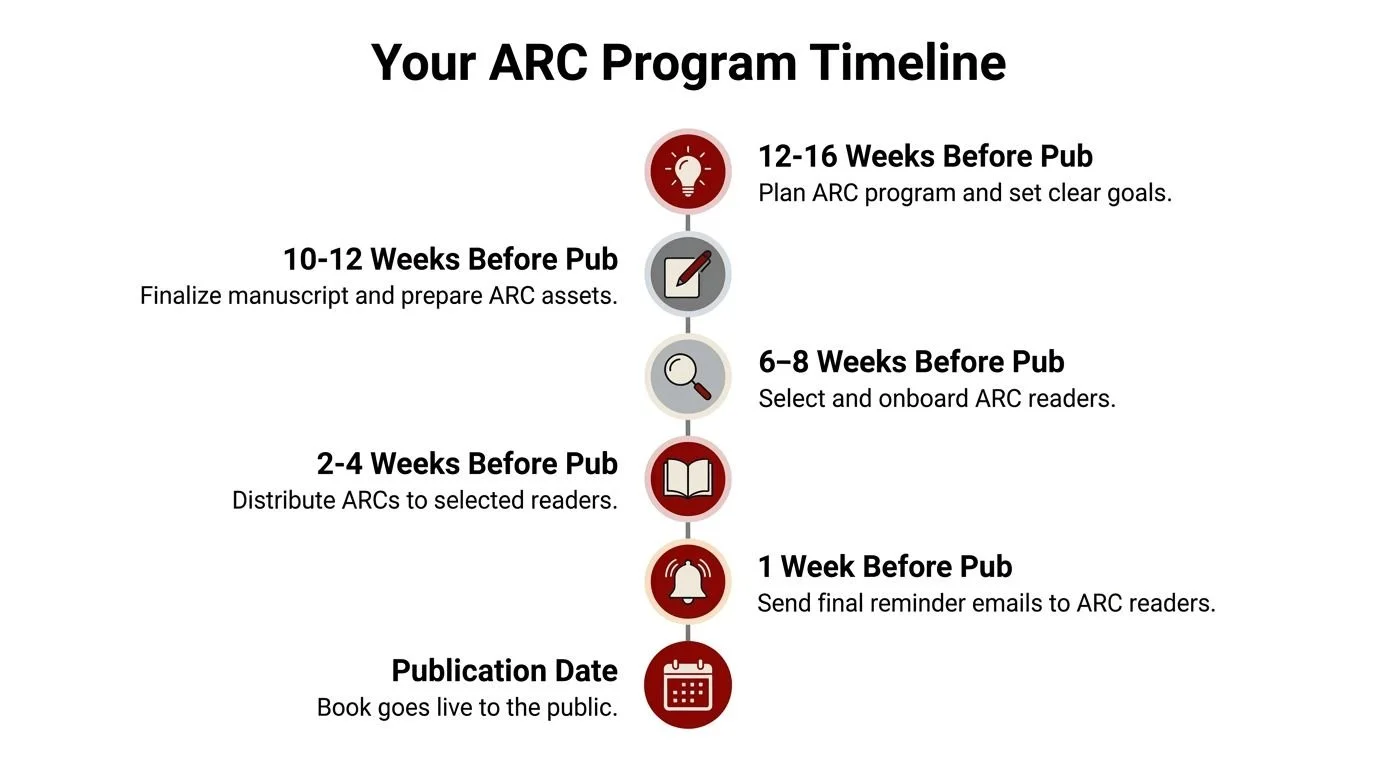
Build the schedule backwards from launch
The cleanest way to plan ARCs is to anchor everything to publication day and work in reverse.
A practical workflow often looks like this:
Four to six weeks before launch
This is the strongest window for most indie releases. It gives readers enough time to finish the book and still leaves room for minor corrections. It also keeps the campaign close enough to publication that enthusiasm doesn’t drift.
Before that window opens
Your manuscript should already be copy-edited and formatted well enough that the book feels professional. Cover presentation matters too. Readers judge an ARC as a product, even when they know it’s an early copy.
One week before launch
Send reminder emails with direct links, review instructions, and the exact date the book goes live if platform timing matters.
A late reminder often rescues more reviews than a second broad outreach push. People forget. Good systems assume that.
Prepare the assets that make readers say yes
The ARC itself needs more than a manuscript file attached to an email.
At minimum, prepare:
A clean reading file: PDF, EPUB, or both, depending on your reader pool
A front cover: Even a temporary near-final cover improves perceived quality
A concise instruction note: Tell readers what the book is, what kind of feedback you want, where to post reviews, and when
A contact point: Readers need a simple way to report download issues or formatting problems
Physical copies can still be useful for certain books, especially illustrated titles, gift books, and children’s books where layout matters. But digital ARCs are faster to deliver and easier to update if you catch a final issue.
Use feedback for small fixes, not major rewrites
Authors sometimes lose discipline at this stage. ARCs should reveal friction you can fix quickly, not reopen every creative decision you’ve already made.
One recent example is typical. Several ARC readers reported confusion in the opening chapters of a project. The issue wasn’t dramatic, but it slowed readers down. A short clarifying paragraph and one tightened transition made the opening noticeably smoother without changing the structure of the book.
That’s the right kind of ARC fix.
A useful triage method is simple:
Fix immediately: repeated confusion, clear typos, broken links, formatting errors
Review carefully: recurring comments about tone, pacing, or clarity
Leave alone: isolated preferences that would push the book off course
If your timeline is collapsing because you’re still resolving editing, design, and distribution details at this stage, that’s usually a sign the process needed tighter coordination earlier.
Selecting the Right ARC Distribution Platform
A weak platform choice creates work you will feel every day of launch week. Files fail to download, readers ask for replacement formats, review reminders go to the wrong people, and nobody on your team can say with confidence who received the latest version.
The right platform does more than deliver an EPUB. It helps you control versioning, reduce support email, track uptake, and keep your review plan aligned with Canadian retail goals. For indie authors in Canada, that usually means choosing based on operational fit first, reach second.
Direct delivery gives you better control
Direct distribution works best when the reader list is intentional. If you already have newsletter subscribers, street team readers, podcast contacts, or prior buyers who reliably review, tools like BookFunnel keep the process organized without adding much overhead.
BookFunnel is practical when you need:
Controlled file delivery: Readers get a download link instead of a bulky attachment
Lower support volume: Device guidance is built into the experience, which cuts back on troubleshooting
Version control: If you update front matter, fix typos, or replace a file, you know which copy went out
Reader-level tracking: You can see who claimed the book, who did not, and where follow-up is required
That tracking matters. “Sent” is not the same as “downloaded,” and “downloaded” is not the same as “finished.” A workable ARC system lets you separate those stages so your reminders go to the right people.
Manual email delivery still has a place for a very small list. Past that point, it breaks down quickly. Files get buried, spam filters interfere, and your spreadsheet becomes the platform.
Broad platforms expand reach, but they add noise
NetGalley serves a different job. It puts your title in front of reviewers, librarians, booksellers, and industry readers who actively browse upcoming releases. That can help if your goal is trade visibility or category exposure beyond your own audience.
The trade-off is less control.
| Option | Best for | Main trade-off |
|---|---|---|
| BookFunnel or similar direct delivery | Curated reader teams and controlled launches | You must recruit and manage the readers yourself |
| NetGalley | Wider professional visibility | Request volume can be higher than review follow-through |
| Manual email | Very small hand-picked list | Tracking, support, and version control become difficult |
I would not choose NetGalley by default for a first Canadian indie launch unless there is a clear reason. It can be useful, but it also introduces approval decisions, wider distribution, and a looser connection between who downloads and who posts where you need visibility.
Match the platform to the Canadian storefront that matters
For Canadian authors, “more reviews” is too vague to guide a platform decision. The better question is where those reviews need to appear and who is likely to post them.
If Indigo.ca matters, recruit readers who already shop and review there. If Kobo visibility matters, prioritize readers who buy ebooks through Kobo and are comfortable reviewing in that ecosystem. A broad international pool may still give helpful feedback, but it often produces reviews on platforms that do little for your Canadian launch plan.
That is why platform choice is really a project management decision. Choose the system that helps you sort readers by target storefront, format preference, and follow-up status. A smaller Canadian ARC team with strong alignment to Amazon.ca, Indigo.ca, or Kobo usually produces more useful launch assets than a much larger general list.
For a broader comparison of retailer and distribution setup, see this guide to self-publishing platforms for Canadian authors.
Pick for workflow, not brand recognition
A recognizable platform can still be the wrong fit. Before you commit, test each option against the work you need to manage:
Can you tag readers by target review site, such as Indigo.ca, Kobo, or Amazon.ca?
Can you confirm who downloaded the file and who still needs a reminder?
Can you replace files without creating confusion about editions?
Can you keep records clean enough to support compliant outreach later under CASL?
That last point gets missed. If your ARC platform leaves you guessing who opted in, who replied, or who should receive follow-up messages, your outreach gets messy fast. The best choice is the one that keeps delivery, segmentation, and tracking tight enough that launch week does not turn into cleanup.
Effective Outreach and Legal Considerations for Your ARC Program
Most ARC problems aren’t caused by bad readers. They’re caused by vague communication. Readers don’t know what they’re agreeing to, when they’re expected to post, or where they should review.
Write invitations that sound professional, not desperate
A good ARC invitation is short, specific, and easy to answer.
Include the essentials:
What the book is: genre, topic, and a brief hook
What you’re asking for: early reading, optional feedback, honest review around launch
What format is available: EPUB, PDF, or print if relevant
What the timeline is: send date, approximate review window, launch date
How to reply: one clear call to action
You don’t need to oversell the book. You need to remove confusion.
A simple communication rhythm works well:
Invitation email: Ask for interest and confirm format preference.
Delivery email: Send the file and instructions.
Midpoint check-in: Brief, polite, and optional.
Final reminder: Close to launch, with review links if available.
Thank-you note: After launch, whether or not they reviewed.
Respect gets better responses than pressure. Ask for an honest review, never a positive one.
CASL compliance is part of the job
Canadian authors can’t treat email recruitment casually. Over 70% of Canadian publishers reported CASL-related compliance challenges in a 2024 BookNet Canada survey, according to this discussion of ARC outreach and compliance risks.
That matters because ARC invitations and reminders may count as commercial electronic messages depending on how you send them and why.
At a practical level, your outreach should include:
Consent: Express or implied, depending on the relationship and context
Clear identification: The recipient should know who is emailing them
A working unsubscribe mechanism: Especially if messages are ongoing
List hygiene: Don’t keep emailing people who didn’t ask to be in the programme
A safer model is to recruit ARC readers through a dedicated signup form or double opt-in list, then confirm interest before each campaign. That gives you a cleaner record of consent and keeps your programme more professional.
If you’re building an ARC team for the long term, treat compliance as a design decision, not a legal afterthought.
Tracking ARC Program Success and Using Feedback
Once the files are out, your advanced reader copy program becomes a tracking problem. If you can’t see what happened, you can’t improve the next launch.
Track the campaign in one place
A simple spreadsheet is still one of the best tools for ARC management. It doesn’t need to be fancy. It does need to be current.
Useful columns include:
Reviewer name
Email or contact method
Platform
Format sent
Date sent
Follow-up date
Review posted
Review link
Notes
That structure helps you spot who follows through, who needs a reminder, and which sources produce the strongest readers. If you want a helpful companion tool for earlier feedback stages, Foglio’s beta reader questionnaire can help standardise comments before you move into ARC mode.
Measure conversion, not just downloads
Downloads don’t tell you whether the programme worked. Reviews do.
Industry data shows that well-managed ARC programs can achieve 40-60% review conversion rates from distributed copies, compared with 10-30% response rates for initial cold outreach, according to this overview of ARC performance benchmarks.
That benchmark changes how you evaluate success. A small, well-selected list can outperform a much larger list built from cold requests.
Track patterns such as:
Which readers post
Which platforms convert best
Which formats produce fewer support issues
Which outreach sources attract reliable readers
Working benchmark: If your list grows but your review conversion drops, the issue usually isn’t scale by itself. It’s targeting.
Separate fixable issues from personal taste
Feedback near launch needs discipline. Not every comment deserves an edit.
A clean sorting method looks like this:
| Type of comment | What to do |
|---|---|
| Typo, broken formatting, repeated confusion | Fix it |
| Multiple readers note the same clarity problem | Review and likely adjust |
| One reader dislikes the style or genre choice | Log it and move on |
After launch, keep the relationship going. Thank readers. Save strong lines for possible blurbs if you have permission. Make notes on who was early, thoughtful, and dependable. Those readers are the start of a future street team, and that’s often more valuable than a one-off campaign.
Frequently Asked Questions About ARC Programs
How many ARC readers do I need?
There isn’t one magic number. A practical benchmark is 75 to 150 ARCs per 1,000 expected preorders. The better your targeting, the less you need to overcompensate with volume. A smaller, well-matched list usually beats a large, random one.
Is it okay to ask ARC readers for a five-star review?
No. Ask for an honest review. Requesting a specific rating is unethical and can create problems with retailer review policies. Your job is to make posting easy, not to script the outcome.
What’s the difference between a beta reader and an ARC reader?
A beta reader helps improve an earlier draft. An ARC reader gets a near-final book and is mainly there to read it before launch and, ideally, review it publicly around release.
When should I send ARCs?
A reliable window is four to six weeks before launch. That gives readers time to finish while still leaving room for minor corrections and reminder emails.
Should I send digital or print ARCs?
Digital is usually more efficient and easier to manage. Print can make sense for illustrated books, children’s titles, and projects where physical presentation affects the reading experience.
What should I track in my ARC spreadsheet?
Track who received the book, what format they got, when you sent it, when you followed up, and whether they posted a review. That’s enough to improve your next campaign without overbuilding the system.
