
Amazon KDP Canada: A 2026 Guide for Authors
If you're a Canadian author staring at the KDP dashboard and wondering whether it’s worth the hassle, the short answer is yes. Amazon KDP Canada is one of the most important publishing channels available to self-published authors in this country, but the generic advice you’ll find online usually skips the parts that trip Canadians up first: tax setup, bank details, ISBN choices, and the print specifications that affect how your book appears on Amazon.ca.
For first-time authors, that gap matters. It’s one thing to upload a manuscript. It’s another to make sure your account is set up correctly, your metadata matches, your book is professionally formatted, and your paperback is positioned to compete in the Canadian market rather than look like a rushed side project.
What Is Amazon KDP and Why It Matters for Canadian Authors
You finish your manuscript, open Amazon KDP, and assume the hard part is over. For a Canadian author, that is usually the point where the actual friction starts. The platform itself is straightforward. The Canadian details around ISBNs, tax setup, pricing, and print logistics are what generic KDP guides often skip.
Amazon KDP is Amazon’s self-publishing platform for ebooks and print books. For Canadians, KDP is the fastest direct route to listing a book on Amazon.ca and Amazon’s other stores without an upfront setup fee.
That direct access is significant because Amazon is a major retail channel for book discovery and sales. For many first-time authors, KDP is the default starting point because it gets a book live quickly and puts it in front of buyers who already shop on Amazon. If your goal is online visibility in Canada, it usually belongs in the plan.
The catch is that KDP solves only part of the publishing job.
It gives you a sales channel, print-on-demand production, and Amazon storefront access. It does not fix weak formatting, mismatched metadata, poor pricing decisions, or confusion around whether to use a free Amazon identifier or your own Canadian ISBN. Those choices affect how professional your book looks and how easily you can expand beyond Amazon later.
That distinction matters more in Canada than many authors expect. Canadian publishers can get free ISBNs through Library and Archives Canada, bank deposits and tax forms need to be set up properly, and print availability can vary depending on where Amazon is producing the book. If those pieces are handled badly at the start, the book can still publish, but you create cleanup work that is harder to fix after launch.
A practical way to look at KDP is this:
| Question | Practical answer |
|---|---|
| Should I use KDP? | Usually yes, if you want your book available on Amazon.ca quickly |
| Should KDP be your only publishing setup? | Often no, especially if you also want wider retail, library, or non-Amazon distribution |
I tell new authors to decide this early. If the book only needs Amazon reach, KDP may cover most of what you need. If you want a cleaner Canadian publishing setup from day one, including the right ISBN strategy and fewer distribution regrets, it helps to compare self-publishing platforms for Canadian authors before you upload. That is also the point where professional help can save time, because fixing account choices and metadata after publication is slower than getting them right the first time.

Setting Up Your KDP Account from Canada
The account setup is simple in theory and annoyingly easy to get wrong in practice. Most Canadian authors don’t get stuck on the login. They get stuck on the payment information and tax interview.
What you need before you start
Open your KDP account when you already have your admin details in front of you. Don’t try to piece them together mid-process.
Have these ready:
Your legal name and address. Use the same details you’ll use for payment and tax records.
Canadian banking details. For direct deposit, you’ll want your institution number, transit number, and account number ready.
Your author or publisher information. If you’re publishing under an imprint name, decide that before you upload.
Your metadata draft. Title, subtitle, author name, and description should be settled early.
The last point sounds minor, but it isn’t. Small metadata mismatches create avoidable listing headaches. When I’m helping authors connect their Canadian ISBN records with KDP, the simplest trick is making sure all metadata matches exactly across platforms before upload. Even tiny differences can cause problems.
The tax interview and payment setup
The KDP tax interview is where many Canadian authors get nervous. It’s also where rushing causes downstream issues.
As a Canadian resident, you’re generally identifying yourself as a non-U.S. publisher or author for U.S. tax purposes. The goal is to complete the interview accurately so Amazon has the correct tax status on file. If you enter the wrong information, you can create payment delays or withholding issues that are frustrating to unwind later.
A few practical habits help:
Answer based on your actual legal and tax status, not on something you saw in a U.S.-based YouTube tutorial.
Use the same legal identity across KDP records. Don’t switch between personal and imprint naming casually.
Double-check payout settings before publishing. Fixing payment information after sales begin is possible, but it’s not the ideal time to discover an error.
Complete the tax interview slowly. Most KDP setup mistakes aren’t technical. They happen because the author assumes the Canadian process is identical to the U.S. one.
Once the account is active, spend a few minutes in the dashboard before uploading your manuscript. Look at where royalties are reported, where paperback and ebook projects sit, and where metadata changes are managed. Authors who do this once early make fewer panicked edits later.
Canadian ISBNs Royalties and Getting Paid
A Canadian author can set up a KDP account correctly and still get tripped up once the book is ready to publish. The sticking points usually show up here: which identifier to use, how royalties are calculated, and when the money arrives. These decisions affect your records, your distribution options, and your cash flow.
Using Amazon identifiers or your own Canadian ISBN
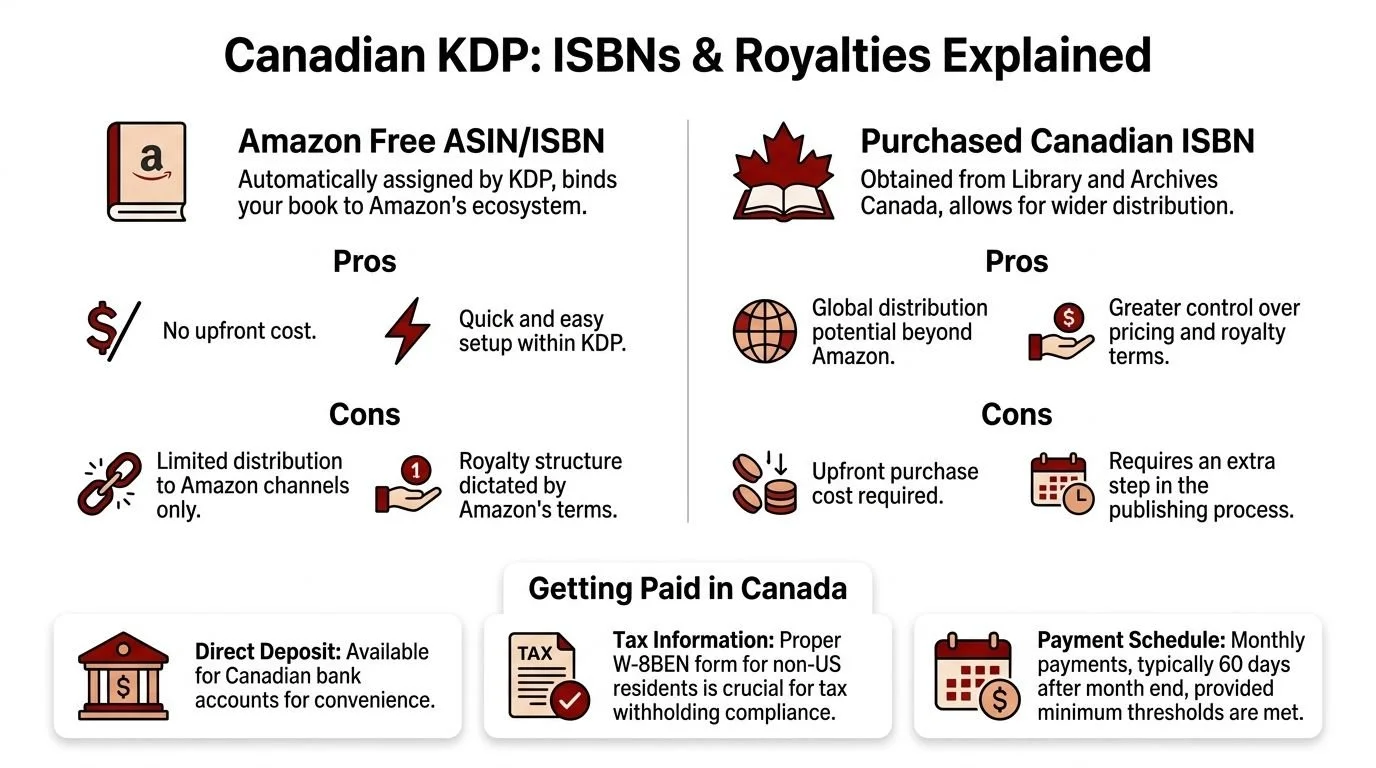
For paperback publishing, the identifier choice is a business decision, not just a setup detail. If the book will live only on Amazon, Amazon’s free identifier can be enough. If you want cleaner ownership records, easier distribution beyond Amazon, or a more consistent publishing footprint under your name or imprint, use your own Canadian ISBN.
That distinction matters more than many first-time authors expect. A free Amazon identifier is convenient, but it keeps the book tied more tightly to Amazon’s system. A Canadian ISBN gives you more flexibility if you later want to sell through other channels, work with bookstores, or keep your metadata consistent across platforms.
| Option | Best for | Main trade-off |
|---|---|---|
| Amazon-provided identifier | Fast setup and Amazon-first publishing | Less independence outside Amazon |
| Your own Canadian ISBN | Authors who want broader control and consistent records | More admin upfront |
If you want a clearer breakdown of the two, this guide to ISBN vs ASIN for Canadian self-publishersexplains where each one fits.
How royalties work for Canadian authors
For royalties, Canadian authors can choose between two KDP royalty structures for ebooks. The 70% royalty applies to many ebooks priced within Amazon’s qualifying range, while the 35% option applies outside that range and in some other situations. The higher percentage is not always the better result.
File size matters. Delivery costs are deducted from ebooks on the 70% plan, so image-heavy books can earn less than expected. That is why novels and text-based nonfiction often fit the 70% structure well, while cookbooks, illustrated guides, children’s books, and workbook-style titles deserve a closer review before pricing is set.
Print royalties follow a different formula. KDP subtracts printing costs before calculating what you earn, so paperback pricing needs its own math. Authors often make avoidable mistakes here by copying their ebook pricing logic over to print and assuming the margin will still work.
If your book includes photographs, charts, interior graphics, or colour pages, review the royalty estimate line by line before you approve the title. This is one of those spots where a second set of experienced eyes can save time and prevent a pricing decision that is expensive to fix later.
When royalties arrive
KDP does not pay on the same timeline as the sale. Canadian authors should expect a delay between seeing sales in the dashboard and receiving the deposit. That catches many first-time publishers off guard, especially if they are watching launch-week numbers closely.
Keep a simple record from the start:
Royalty statements downloaded from KDP
Bank deposits received
Which title or format generated each payment
Any currency conversion notes from your bank
This becomes much more useful at tax time, particularly if you publish in more than one format or receive payments in different currencies. For Canadian authors, the cleanest approach is to treat royalties as bookkeeping from day one, not as something to sort out months later.
Local Printing and Distribution in the Canadian Market
A first-time Canadian author often notices the problem only after launch. The book is live on Amazon.ca, but delivery looks slower than readers expect, the listing feels less competitive, and the paperback does not behave like a normal domestic purchase.
Why local printing matters in Canada
For Canadian authors, local print eligibility dramatically improves the buying experience. A book that can be produced closer to the customer usually reaches readers faster and fits more naturally into the Amazon.ca shopping flow.
That matters more than many new publishers expect.
On Amazon, small logistics details affect conversion. If a reader sees a paperback with a longer delivery window or a listing that feels like a special-order item, some will wait, and some will leave. For a Canadian author trying to build early momentum, that friction costs real sales.
What affects local print eligibility
KDP does not treat every paperback the same. Local production depends on whether the book fits the specifications Amazon can print efficiently for the Canadian market.
The common trouble spots are usually straightforward, but they are expensive to ignore:
Trim size. Standard formats are usually the safest choice for Canadian KDP paperbacks.
Interior file setup. Page dimensions, bleed, and margins all need to match the trim size exactly.
Cover calculations. Spine width changes with page count and paper type, so a cover built on the wrong template often needs to be rebuilt.
Image quality and export settings. Files can upload successfully and still produce weak print results.
This is one of the less obvious Canadian friction points. Generic KDP advice often stops at "upload your file and approve the proof." In practice, authors here need to pay closer attention to production choices because printing logistics affect customer experience, not just print quality.
The trade-off is simple. KDP print-on-demand is efficient for testing demand, keeping upfront costs low, and avoiding inventory. It is not always the best fit for every book. If you are comparing short-run digital printing, offset runs, and Amazon POD, this guide to print on demand versus offset printing in Canada helps clarify which option fits your title, budget, and sales expectations.
I usually tell Canadian authors to be cautious with books that include heavy colour, unusual trim sizes, or design-sensitive interiors. Those projects can still work on KDP, but they deserve a closer production review before you publish. That is often the point where experienced help saves time, avoids repeated file corrections, and prevents a listing from going live with avoidable limitations.
A Formatting and Submission Checklist for KDP
You finish the manuscript, upload the files, and expect the hard part to be over. Then KDP flags the cover, the previewer shows broken chapter starts, or the proof arrives with margins that looked fine on screen but feel wrong in print.
That is a common first-time author experience. For Canadian publishers using KDP, formatting errors also cost time because every correction can delay approval, push back launch timing, and create extra proofing rounds.
Interior file checklist
A clean interior file starts with production decisions made early, not fixes added at upload.
Choose the right file for the format. Print books usually need a print-ready PDF. Ebooks need files built for reflowable reading on Kindle devices and apps.
Lock in the trim size before typesetting gets too far. Late trim changes often force page count shifts, margin adjustments, and header cleanup.
Set margins, gutters, and page breaks carefully. This matters even more for longer paperbacks, where binding allowance affects readability.
Embed fonts if your workflow requires it. Font substitution can change line breaks, page count, and the overall look of the book.
Review front matter and back matter in order. Title page, copyright page, table of contents, acknowledgments, and author bio should appear where readers expect them.
Check headers, footers, and page numbers after final edits. These are often correct until one late revision throws them off.
For ebooks, structure matters more than visual control. A Kindle file should be built for flexible screen sizes, adjustable text, and clickable navigation. Authors who try to force a print layout into an ebook usually end up with a file that passes upload but reads poorly.
Cover file checklist
KDP’s Cover Creator can be enough for a simple project. It is less effective when the book needs strong category positioning or careful print alignment.
Before you upload a print cover, check the full wrap file against the final specifications:
| Check | Why it matters |
|---|---|
| Correct trim size | The front, back, and spine must match the book block exactly |
| Accurate spine width | Even a small miscalculation can throw off spine text and alignment |
| High-resolution imagery | Blurry covers look weak in search results and worse in print |
| Readable typography | The title needs to hold up at thumbnail size on Amazon.ca |
| Barcode space on the back cover | KDP needs a clear area, or the layout can feel cramped |
One practical point Canadian authors often miss is timing. If your page count changes after final proofreading, the spine width changes too. That can turn a finished cover into a file that needs revision.
What usually goes wrong
The same problems show up again and again, especially on first books:
Metadata does not match the files
The print PDF exports at the wrong dimensions
The author uploads an ebook cover for a paperback
Front matter is incomplete, inconsistent, or out of order
No one checks a printed proof before approval
KDP will often accept files that still produce a weak reading or print experience. Upload success is only the first checkpoint.
To avoid these issues, authors often use professional formatters, cover designers, or full-service publishing support. Foglio Publishing handles editing, design, typesetting, ebook preparation, ISBN support, and distribution setup for Canadian self-publishers.
Pricing and Marketing Your Book on Amazon Canada
Pricing a book on Amazon.ca is partly math and partly positioning. New authors often focus too hard on what feels affordable and not enough on what looks credible for the category.
Pricing decisions that make sense
Start with context. Search books in your genre on Amazon.ca and study the range. Don’t copy blindly, but do notice patterns.
Then ask practical questions:
Is this a short introductory book or a substantial one?
Is the category price-sensitive?
Does the cover and interior justify the asking price?
Will a very low price make the book look disposable rather than accessible?
For ebooks, the royalty bands discussed earlier matter, but pricing still has to make sense to a Canadian reader browsing similar titles. A low price can help remove friction for an unknown author. It can also make the book look undercooked if the category usually signals more authority through a higher list price.
For paperbacks, be careful about racing to the bottom. If the physical book feels thin, has weak design, or looks inconsistent inside, lower pricing won’t solve the bigger problem.
KDP Select and Amazon Ads
KDP Select can be useful, but it comes with a real trade-off. In exchange for Amazon-specific promotional tools and subscription visibility, your ebook is exclusive to Amazon for the enrolment period.
That can work well if:
Amazon is your main sales focus
You want to test Kindle Unlimited visibility
You’re launching a genre title that performs well inside Amazon’s ecosystem
It may not fit if you want your ebook widely available on other retailers from day one.
For Amazon Ads, keep your campaigns tightly scoped at the start. Use clear Canadian targeting where possible, watch your search term relevance, and don’t assume traffic equals profit. A vague campaign with broad keywords burns money quickly. A tighter campaign built around genre, topic, and comparable reader intent usually gives you cleaner data.
Frequently Asked Questions for Canadian KDP Authors
Do I need a business to publish on Amazon KDP in Canada
No, many authors publish as individuals. What matters is that your legal, tax, and banking details are entered consistently. If you later create a publishing imprint or business structure, update your records carefully rather than mixing identities across platforms.
Can I use a Canadian ISBN on KDP and still sell elsewhere
Yes, if you control your own ISBN and your metadata is consistent, you can use that identifier as part of a wider distribution plan. The key is accuracy. Title, subtitle, author name, edition wording, and imprint details need to match cleanly.
How is KDP income taxed in Canada
Your KDP income is generally part of your taxable income in Canada. The platform setup and tax interview help determine how Amazon handles its side of reporting and withholding, but your Canadian tax filing responsibilities still remain. For personal guidance, speak with an accountant familiar with self-employment or publishing income.
Why isn’t my paperback showing as Prime on Amazon.ca
Usually because something about the book’s production path or listing isn’t lining up as expected. Common causes include non-standard specs, file issues, listing delays, or production settings that don’t align with local print eligibility. If Prime status is important to your sales strategy, review your trim size, cover setup, and paperback configuration carefully.
Can I change my book after it goes live on KDP
Yes. You can usually update metadata, pricing, manuscript files, and cover files. But frequent changes create room for mistakes, especially if you’re also using your own ISBN or distributing elsewhere. Treat updates like controlled revisions, not casual edits.
Should I publish ebook and paperback at the same time
Often yes, if both editions are ready and professionally prepared. A coordinated launch looks stronger and gives readers format choice immediately. If one format is rushed, though, it’s better to stagger the release than publish a weak edition that hurts first impressions.
What’s the most common KDP mistake Canadian authors make
Metadata inconsistency is high on the list. Authors change the subtitle slightly, alter punctuation, swap author naming styles, or upload files that don’t match the information attached to the ISBN or listing. Those details seem small until they interfere with approval, discoverability, or distribution records.
If you want help getting your book ready for amazon kdp canada without guessing your way through formatting, ISBN setup, design, and distribution choices, Foglio Publishing offers done-with-you support for Canadian authors who want a market-ready result rather than a trial-and-error upload.
