
First Person Narrative: A Guide for Canadian Writers
TL;DR: First-person narrative is a point of view where the story is told by a character using I or we, which gives readers direct access to that narrator’s experience. In Canada, memoirs and personal narratives made up 18% of all self-published titles, up 50% since 2017, and 75% of authors report higher reader engagement with first-person storytelling according to the verified Canadian market data provided.
You’re probably here because your draft already has a voice, but you’re not fully sure whether that voice is helping the book or weakening it. That’s common. A first-time author often chooses first person because it feels natural, then encounters fundamental questions later: why does this chapter sound flat, why does the narrator keep over-explaining, and why does the story feel cramped even when the material is strong?
The short answer is that first person is one of the most powerful narrative tools available to a writer, but it’s also one of the easiest to misuse. It can create immediacy, intimacy, tension, and a memorable voice. It can also trap the story inside one repetitive mind if the structure isn’t doing enough work.
What Is First Person Narrative?
A writer finishes a memoir draft, hands it to an editor, and asks why the book still feels distant even though every chapter uses "I." The answer is usually structural. First person works only when the reader is placed inside one person’s lived experience, with all the access and all the limits that choice creates.
First-person narrative is a point of view in which the story is told by a narrator using I or we. That narrator may be the central figure, a participant on the edge of the action, or a witness trying to make sense of events after the fact. In every case, the reader receives the story through that narrator’s vocabulary, bias, memory, and blind spots.
For editors, that last point is the one that matters.
First person sets a clear contract with the reader. The book will not present a neutral camera. It will present a filtered account. In fiction, that usually means stronger voice and tighter emotional access. In memoir, it also means the manuscript has to earn trust on the page. If the narrator sounds inconsistent, knows things they could not know, or explains too much, the problem is not just style. The point of view itself starts to wobble.
That is why first person suits manuscripts where interpretation carries as much weight as plot. It is often the right choice for memoir, confessional nonfiction, and novels built around secrecy, shame, obsession, grief, or self-deception. If the reader needs to feel the narrator choosing words, hiding facts, revising memory, or misunderstanding events in real time, first person gives you the right frame.
For Canadian self-publishers, this choice has another layer. Memoir and personal nonfiction are common categories in the market, but they also bring legal exposure that first-time authors tend to underestimate. If your book names living people, recounts family conflict, or describes workplace, medical, or criminal matters, point of view will not protect you from defamation or privacy concerns. It will only shape how those risks appear on the page. Authors planning personal nonfiction should understand the editorial and legal side of publishing a memoir in Canada before they finalize the manuscript.
A practical test helps. If the book’s main force comes from what happened to the narrator, how the narrator understood it at the time, and how that understanding changes, first person is usually a strong fit.
It does not fix weak material. A flat scene stays flat in first person. The manuscript still needs selection, pacing, conflict, and control over what the narrator notices and withholds.
Comparing First Person to Other Points of View
A common editorial problem looks like this: the manuscript is clean, the scenes are competent, and the book still feels misaligned. The issue is often point of view. Authors choose first person because it feels personal, then discover too late that the story needs more range, more concealment, or more authority than "I" can comfortably provide.
Point of view sets the limits of the book. It controls what the reader can know, how information arrives, and how much interpretive work the narrator does on the page. In self-publishing, where structural revision is often compressed or skipped, a weak POV choice can survive all the way to print.
Here’s the visual overview.
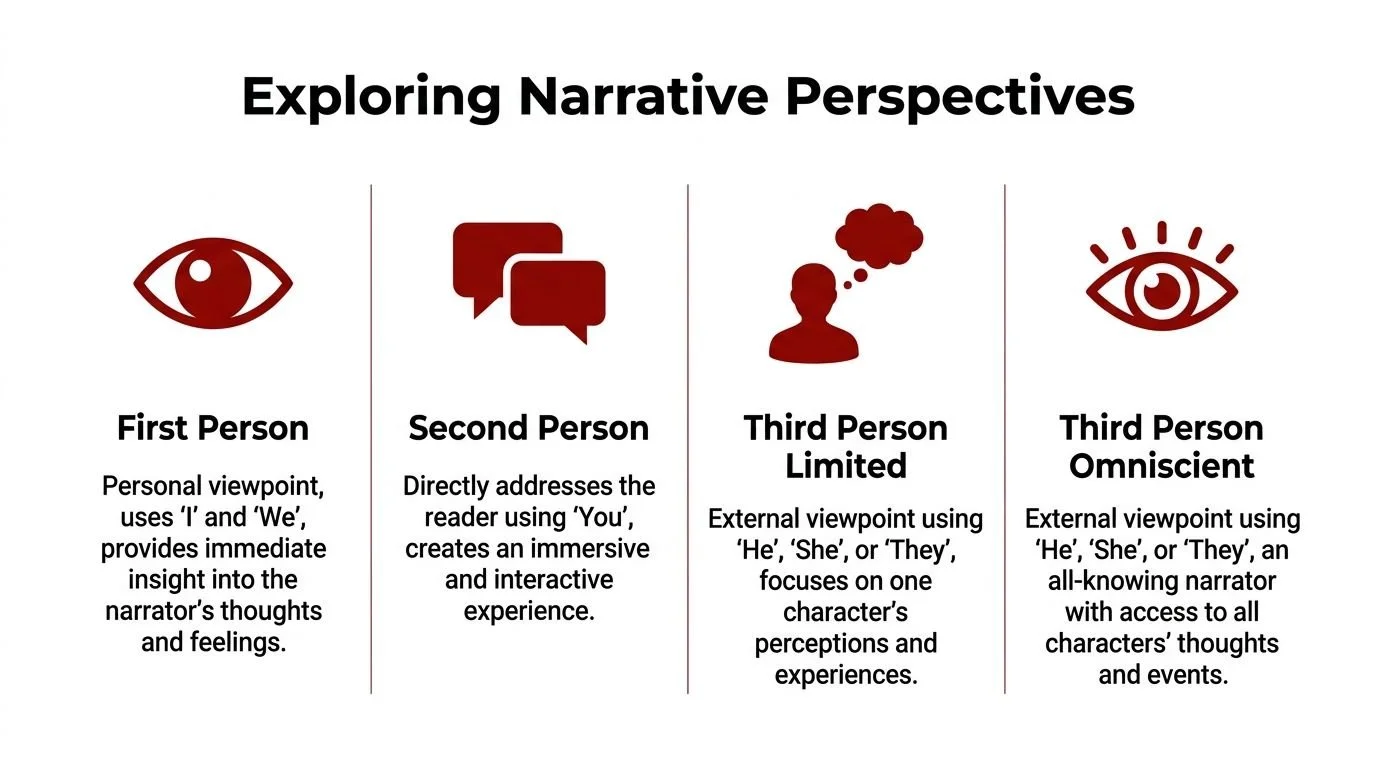
Point of view comparison
| Point of View | Pronouns | Reader Experience | Best For |
|---|---|---|---|
| First person | I, we | Intimate, subjective, immediate | Memoir, confessional nonfiction, voice-driven fiction |
| Second person | you | Direct, immersive, stylised | Experimental work, interactive writing, select nonfiction |
| Third person limited | he, she, they | Close but slightly more flexible | Most commercial fiction, stories needing focus without full subjectivity |
| Third person omniscient | he, she, they | Broad, panoramic, authorial | Multi-character stories, generational narratives, wider social scope |
The practical difference is structural.
First person binds the reader to one consciousness. That gives you pressure, intimacy, and a strong line of interpretation. It also creates constraints. You cannot move freely into other characters’ motives, summarise events the narrator could not witness, or explain context too early without making the narrator sound unnaturally informed.
Third person limited solves some of those problems. It still stays close to one character, but it usually gives the prose more room to breathe. Authors who overwrite in first person often produce cleaner scenes in third limited because the narrative no longer has to sound like someone constantly talking.
Third person omniscient serves a different job. It works best when the subject is bigger than any one person: a family across decades, a community under pressure, a social system, a political moment. Newer writers often choose omniscient because they want freedom. The trade-off is control. Without a firm editorial hand, omniscient quickly turns into summary, head-hopping, or commentary that drains tension.
Second person is the hardest to sustain at book length. It can create force in short work, hybrid nonfiction, or psychologically split narratives. In full manuscripts, it often reads like a stylistic decision made before the author tested whether the material could carry it.
When first person is the better choice
First person tends to outperform other options when the narrator’s way of telling is part of the story itself. That includes memoir, personal nonfiction, and fiction built around secrecy, guilt, obsession, misreading, or revision of memory. In those books, the sentence-level bias is not a flaw to manage. It is part of the design.
From an editor’s perspective, the strongest first-person manuscripts usually do one of two things well. They either deliver a voice the reader would follow through almost any subject matter, or they use the narrator’s limitations to create tension the story could not produce in another POV.
For Canadian memoirists, there is another trade-off. First person can make a book feel more credible because the experience is presented as lived and owned. That same closeness can increase legal and editorial pressure if the manuscript identifies living people, repeats allegations, or presents uncertain memory as settled fact. Authors working on life writing should understand how narrative decisions intersect with editing and risk before publication. This guide to memoir publishing in Canada is a useful starting point.
Use a simple test during planning or revision:
Choose first person if the book rises or falls on voice, confession, unstable memory, or a narrator’s interpretation of events.
Choose third person limited if you need closeness but also need cleaner exposition, broader scene handling, or more control over pacing.
Choose omniscient if the book’s real subject is collective, historical, or systemic, and you can maintain strong narrative authority.
Use second person carefully if the manuscript has a clear formal reason for it, not just a wish to sound unusual.
A strong POV choice does more than shape the reading experience. It determines what the manuscript can carry without strain.

The Mechanics of First Person Narration
A first-time author often brings me a draft that feels intimate on the sentence level but unstable on the page. The narrator sounds one age in chapter one, another in chapter three, and somehow knows things they could not know yet. That is usually not a talent problem. It is a mechanics problem.
First person works best when the manuscript controls three elements with care: voice, reliability, and psychic distance. If one slips, readers feel it fast.
Voice and tense
Voice is the narrator’s language under pressure. It shows up in word choice, rhythm, what the narrator notices first, and what they avoid naming. A strong first-person voice does more than sound distinctive. It sets limits on what the prose can plausibly say.
Tense affects those limits. Present tense gives less room for summary and reflection, which can help a story feel immediate. Past tense gives the narrator more freedom to interpret events, compress time, and add judgment. For memoir, that choice carries extra weight. A reflective past-tense voice can help signal that the writer is remembering and shaping experience, not producing a verbatim record. In the Canadian self-publishing market, that distinction can matter if a manuscript describes disputed events or identifies living people.
Use one test throughout the draft:
“Would this character say or think this in this moment?”
That question catches polished lines that do not belong to the narrator, explanation that arrives too early, and observations that sound more like author commentary than lived perception.
Voice should also respond to context. A narrator speaking to a judge, a sibling, or an ex-partner should not sound identical in all three scenes. The underlying voice stays recognizable. The sentence length, confidence, and level of self-protection can shift.
Narrator reliability
Reliable does not mean objective. It means the manuscript handles the narrator’s limits with control.
Some first-person narrators misread motives. Some leave things out. Some protect themselves with selective memory. Those choices can strengthen a book if the pattern is clear and intentional. They weaken it when the draft sends mixed signals by accident.
In structural edits, I often mark places where the narrator knows too much too soon, or where a later revelation contradicts an earlier scene without any sign of self-deception, repression, or hindsight. Readers will accept a biased narrator. They will not accept a careless one.
A practical distinction helps here:
Accidental unreliability comes from inconsistent drafting.
Intentional unreliability comes from a designed gap between what the narrator says and what the reader can infer.
Memoirists need particular discipline on this point. If memory is uncertain, write that uncertainty into the sentence. “I remember,” “as far as I knew then,” or a clearly framed reconstruction can do more than protect voice. In some nonfiction contexts, it can also reduce legal exposure by avoiding claims of certainty the manuscript cannot support.
Psychic distance
Psychic distance is the space between the narrator’s raw experience and the prose on the page. In first person, writers often stay too close for too long. The result is a manuscript full of explanation instead of movement.
When every action arrives with a paragraph of interpretation, scenes lose force. Dialogue stalls. The reader stops participating because the narrator has already done all the thinking for them. In memoir and children’s publishing, there is a production trade-off as well. Extra introspection increases word count, which can affect trim size, illustration balance, and print cost even when the writing itself is sound.
Vary distance on purpose:
Very close distance: useful for fear, shame, desire, shock, and confession
Moderate distance: useful for dialogue, scene progression, and observation
Pulled-back distance: useful for context, time shifts, and measured reflection
One of the simplest editorial fixes is to cut summary thought and restore physical evidence. Replace a block of explanation with one concrete action, one sensory detail, and one line of thought that belongs only to this narrator.
For example, instead of explaining that the narrator felt judged, let the scene carry it: the missed handshake, the glance at the stained cuff, the decision to keep talking anyway. That balance is what makes first person feel close without becoming airless.
Common First Person Narrative Pitfalls
A writer delivers a memoir draft in a strong, confessional voice. The first chapter feels intimate. By chapter three, every scene is being explained, other people’s motives are stated as fact, and the narrator sounds more like a commentator than a person living through events. That pattern is common in first-person manuscripts, and it is fixable.
The point of view is rarely the problem on its own. Structure is. In editorial terms, first person puts pressure on scene control, knowledge limits, and voice consistency. If those parts are loose, the manuscript starts to feel repetitive or unearned, even when the core story is strong.
Over-explaining thoughts
This is one of the first problems I mark in a structural edit, especially in early memoir and autobiographical fiction.
The narrator reacts, then explains the reaction, then explains why the explanation matters. On the page, that reads as hesitation. It slows the scene and asks the reader to accept an emotional conclusion without seeing enough evidence.
Before
I was angry when she said that because it reminded me of all the times people had underestimated me in the past, and I felt that familiar frustration rising again inside me.
After
She smiled when she said it. I folded the receipt so hard it split down the middle.
The revision gives the reader something to witness. It keeps the narrator in the scene. It also preserves momentum, which matters in first person because too much interpretation can make every chapter sound like it is running at the same emotional volume.
Inconsistent voice
Voice drift is a structural problem, not just a style problem.
A believable first-person narrator has a pattern of language, perception, and self-awareness. If that pattern changes without a clear story reason, readers feel the author stepping in. In self-publishing, this often happens after several rounds of solo revision, where line-level polishing starts sanding away the narrator’s original cadence.
These are the usual signs:
The polished patch: the prose becomes more literary than this narrator would naturally sound
The exposition patch: the narrator starts briefing the reader instead of experiencing the scene
The genre patch: the book suddenly imitates thriller, romance, or literary-fiction language for a chapter or two
A quick diagnostic helps:
| Problem sign | What it usually means | Fix |
|---|---|---|
| The narrator uses language they normally wouldn’t | The author stepped in | Rewrite in the narrator’s natural syntax |
| The paragraph explains what readers already infer | Fear of being unclear | Cut the explanation and test with beta readers |
| Emotional scenes sound generic | The voice drops out under pressure | Replace abstract feeling words with specific perception or action |
If you are unsure what kind of editing would catch this, a guide to different types of manuscript editing can help you match the problem to the right stage of revision.
The narrator knows too much
Readers will give a first-person narrator a lot of room for bias, misreading, and flawed memory. They will not forgive information the narrator could not reasonably have.
That is where trust breaks.
A first-person narrator can report what they saw, what they inferred, and what they later learned. They cannot present another person’s hidden motive as settled fact unless the story has supplied a believable basis for that knowledge.
Before
Mark resented me for getting the promotion and planned to embarrass me at the meeting.
After
Mark congratulated me without looking up from his laptop. At the meeting, he corrected me twice on details he’d never cared about before.
The second version preserves tension because it stays within the narrator’s access. It also leaves room for ambiguity, which is often more persuasive than overstatement.
Memoir risks in Canada
Memoir adds a separate layer of editorial risk. The issue is not only whether the voice is compelling. The issue is whether the manuscript makes claims, identifies people, or describes events in ways that create avoidable legal exposure.
This matters in the Canadian self-publishing market because first-time memoirists often assume that a true story is automatically safe to print. It is not that simple. Truth, memory, documentation, privacy, and identifiability all affect risk, and those questions usually surface late if no one raises them during revision.
Watch for these pressure points:
Identifiable individuals: changing a name may not protect you if the person is still recognisable through role, location, family details, or a specific incident
Allegations stated as fact: this is a common problem when memory is partial, old, emotional, or disputed
Private information: medical, financial, workplace, and family details can create ethical and legal concerns even when they are accurate
Children and vulnerable people: extra caution is wise because consent, privacy, and long-term harm are harder to assess
From an editor’s perspective, the trade-off is straightforward. Specificity gives memoir its force. Specificity also increases risk. The answer is not to flatten the story. The answer is to revise with intent, verify what can be verified, flag what is uncertain, and get legal advice where the manuscript moves beyond ordinary editorial judgment.
Revising and Editing Your First Person Manuscript
Revision in first person is mostly subtraction. You are removing whatever muffles the narrator’s actual presence. That includes repetitive thought loops, unnecessary filter phrases, false insight, and scenes that exist only to explain the story instead of advancing it.
A useful revision pass is to read every scene and ask what the reader receives that only this narrator could provide. If the answer is “not much,” the voice may be decorative rather than structural.
A practical self-edit checklist
Use these questions during revision, one chapter at a time:
Is the voice consistent under stress: Does the narrator still sound like the same person in conflict, reflection, and dialogue-heavy scenes?
Would this character say or think this in this moment: If not, the line is probably explanatory padding.
What does the narrator not know yet: Mark those limits clearly so later scenes don’t leak information backward.
Where am I summarising emotion instead of dramatising it: Replace explanation with action, sensory detail, or sharper interiority.
Have I earned this level of reflection: Immediate scenes usually need less analysis than retrospective passages.
For authors who want a clearer sense of where structural editing ends and copyediting begins, this breakdown of every type of manuscript editing explained is a practical reference.
What to cut and what to keep
First person improves when you cut filter phrases that sit between the reader and the scene.
Common examples include:
I saw
I felt
I realised
I noticed
I thought to myself
These aren’t always wrong. They’re wrong when they weaken a sentence that could be more direct.
Weaker: I noticed the kitchen was too quiet.
Stronger: The kitchen was too quiet.
Keep the filters when perception itself matters. Cut them when they only add distance.
Also watch for repeated emotional translation. If a narrator says they’re ashamed, then describes blushing, then explains why they’re ashamed, you probably need one of those, not all three.
When legal review belongs in revision
Memoirists often treat legal review as a final administrative task. It belongs earlier than that.
If your manuscript includes sensitive family history, workplace allegations, criminal conduct, addiction, abuse, medical information, or identifiable conflict, legal review may affect structure, naming, scene framing, and documentation choices. It’s easier to solve those questions in revision than after formatting and cover design are already underway.
Revision isn’t only about making the book stronger. It’s also about making the book publishable.
That matters in self-publishing because the author carries the final responsibility. A strong manuscript is not only vivid and honest. It is careful about what it claims, how it identifies people, and what can be supported if challenged.
Conclusion: Your Path to a Powerful Narrative
A strong first person narrative does one thing exceptionally well. It makes the reader feel that a human presence is guiding every page. Not an abstract storyteller. Not a camera. A mind with preferences, blind spots, habits, fear, humour, and pressure.
That intimacy is the primary advantage of first person. It’s also the reason the form demands discipline. The narrator cannot wander into information they don’t have. They can’t explain every feeling without flattening the scene. They can’t sound poetic in one paragraph and generic in the next unless the shift is earned.
The trade-off is worth it when the material depends on lived perception. Memoir, personal nonfiction, confessional fiction, and voice-led storytelling often become sharper in first person because the narrative lens is part of the story itself.
For Canadian self-publishing authors, that choice also connects to practical publishing realities. A good first-person manuscript needs more than compelling prose. It needs structural clarity, controlled voice, clean formatting, and, in memoir, careful attention to privacy and defamation concerns. Those pieces are connected. They shouldn’t be treated as separate problems.
If you’re still deciding whether your draft is in the right POV, test one chapter in another mode. If you’re already committed to first person, revise with a harder editorial eye. Cut what the reader can infer. Protect what the narrator can know. Keep asking whether the voice is carrying the story or merely narrating it.
When you’re ready to move from manuscript to finished book, it helps to understand the broader self-publishing path in Canada, from editing through production and distribution. This guide on how to self-publish a book in Canada is a useful next step.
Frequently Asked Questions About First Person Narrative
What is first person narrative?
First person narrative is a point of view in which a character tells the story using I or we. The reader experiences events through that narrator’s knowledge, interpretation, and emotional lens.
Is first person narrative good for beginners?
Yes, but it isn’t automatically easier. It can feel natural to draft in first person, yet revision is often demanding because voice consistency, limited knowledge, and over-explaining become very visible.
Can you switch from third person to first person during revision?
Yes. A switch can strengthen a manuscript if the story needs more immediacy or a stronger voice. The key is to revise the entire manuscript for knowledge limits, sentence rhythm, and character language rather than only changing pronouns.
What is the biggest mistake in first person writing?
The most common mistake is over-explaining what the narrator thinks or feels. Strong first person usually trusts scene, action, and implication more than commentary. Can a first-person narrator be unreliable? Yes. In fact, first person is one of the best POVs for deliberate unreliability. The important part is authorial control. Contradictions, omissions, and bias should feel intentional, not accidental.
Is first person a good choice for memoir?
Often, yes. Memoir usually benefits from the intimacy and directness of first person. But memoirists also need to think carefully about privacy, defamation risk, and how they portray real people.
How do you keep a first-person voice consistent?
Use a recurring check: Would this character actually say or think this in this moment? That question helps catch exposition, author intrusion, and language that doesn’t fit the narrator.
