
How to Write a Plot Synopsis: An Author's Guide
You’ve finished the manuscript, and the synopsis is the part that suddenly makes you feel like you no longer understand your own book. That’s normal. How to write a plot synopsis comes down to one practical shift: stop trying to compress every chapter and start tracing the story’s core chain of cause and effect from opening problem to final resolution. A good synopsis is concise, complete, and structurally honest. It tells a publishing professional, or you, whether the story holds together.
What Is a Plot Synopsis and Why Does It Matter
A plot synopsis is a concise summary of the full narrative arc, including the ending. It introduces the central character, identifies the problem, tracks the major turning points, and explains how the story resolves. It is not a teaser. It is not sales copy. It is not the copy you’d put on a retailer page or the language you’d use on a back cover. If you need that distinction clarified, compare it with a marketing-focused piece such as this guide on how to design the back cover of a book.
That difference matters because a synopsis serves a different job. A blurb withholds. A synopsis reveals. A blurb creates curiosity. A synopsis demonstrates control.
Practical rule: If your synopsis ends with a question mark instead of the actual ending, it isn’t a synopsis yet.
Writers often feel that a plot synopsis is reductive. In actuality, it’s one of the sharpest writing tools you have. If you can’t explain why one major event leads to the next, the problem usually isn’t the synopsis. The problem is in the manuscript’s structure, motivation, or pacing.
Use the synopsis as an X-ray. It shows whether the middle escalates, whether the climax answers the central conflict, and whether the resolution feels earned. That’s why agents, editors, and experienced indie authors take it seriously.
The Anatomy of a Compelling Synopsis
A workable synopsis starts with the story’s narrative spine. If you don’t isolate that spine first, you’ll end up writing a crowded recap full of side roads.
Find the narrative spine first
Before drafting sentences, identify the five elements that carry the book:
The protagonist and their core motivation
Name who the story is about and what they want before the plot knocks them off balance. This gives the synopsis a human centre. Without it, the summary reads like events happening to nobody in particular.
The first major disruption
Something changes, and the protagonist can’t stay in their old life. This is the moment that activates the story rather than merely describing the setup.
The central conflict and escalation
A synopsis earns its keep in the middle. You need to show not just that problems arise, but that each problem intensifies pressure on the protagonist’s goal.
The stakes
Stakes answer the question, “Why does this matter?” If the protagonist fails, what is lost? Safety, identity, love, belonging, reputation, family, freedom, purpose. Sometimes several at once.
The climax and resolution
Include the ending. Every time. The synopsis must show the decisive confrontation and the new reality that follows it.
A useful test is whether each element would still matter if you removed three supporting characters and two subplots. If yes, it belongs in the synopsis.
What belongs in and what gets cut
Many authors overwrite the synopsis because they confuse significance with affection. You may love a side character, a comic exchange, or a textured setting detail. That doesn’t mean it belongs here.
Use this filter:
| Keep it if it does this | Cut it if it only does this |
|---|---|
| Changes the protagonist’s decision | Adds atmosphere only |
| Raises the stakes | Shows personality without affecting plot |
| Creates the next major obstacle | Explains lore in depth |
| Alters the ending | Supports a subplot that never intersects the climax |
A synopsis should also sound clean and controlled. That usually means avoiding decorative phrasing and favouring direct statements of action. “She discovers,” “he refuses,” “they conceal,” “the plan fails,” “the truth emerges.” Strong verbs do most of the work in a plot synopsis.
For many authors, it helps to start with a stripped-back source document before writing polished prose. A chapter reduction exercise can help, especially if you’ve already prepared a book excerpt selection process and know which scenes truly represent the story.
The synopsis isn’t there to preserve every pleasure of the manuscript. It’s there to show what the story is built on.
How to Draft Your Synopsis with Cause and Effect
Most weak synopses fail for one reason. They read like a list. This happened, then this happened, then this happened. The events may all be accurate, but the story feels mechanical because the logic between events stays hidden.
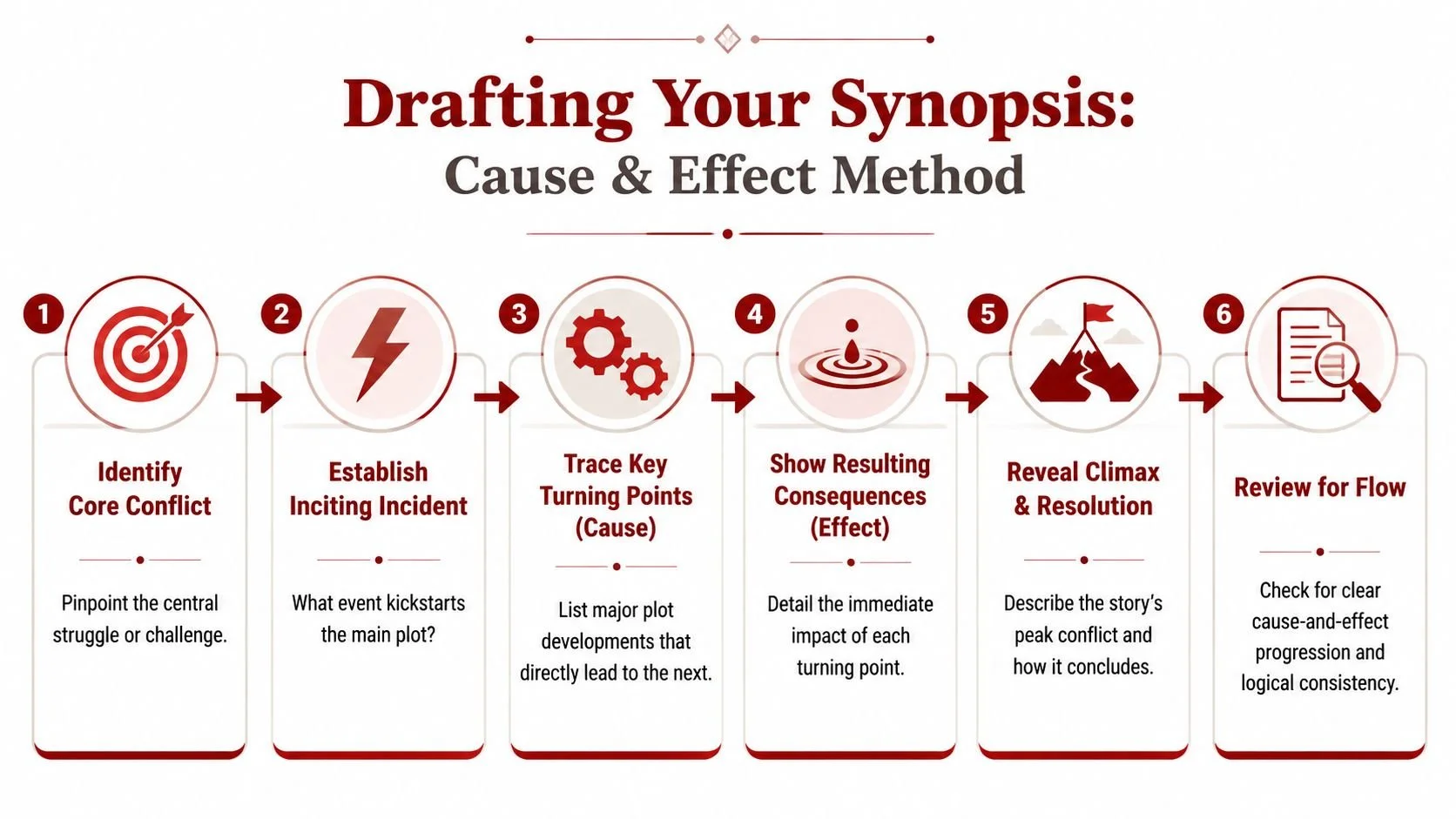
Use the Because Then test
A stronger method comes from Marissa Meyer’s synopsis framework. After reducing chapters to single-sentence units, she advises reading through the synopsis using a Because/Then structure so plot holes become visible. Her method treats coherence as cause and effect, not chronology, and builds around five critical plot elements rather than chapter-by-chapter retelling. See Meyer’s explanation of the Because/Then synopsis method.
Here’s why it works. Chronology only tells us order. Cause and effect tells us meaning.
Compare these approaches:
| Chronological summary | Cause and effect summary |
|---|---|
| Mara inherits the inn. She moves home. She meets her rival. The town objects. | Mara inherits the inn, because her aunt dies unexpectedly, forcing her home. Then she discovers her rival plans to buy the property, which turns grief into a fight for control. |
| A detective finds a letter. He questions a witness. He gets suspended. | A detective finds a letter implicating city officials, because he reopens a buried case. Then his superiors suspend him to stop the investigation. |
The second version creates momentum. It answers why each beat matters.
If you can place “because” or “then” between major turns and the logic feels thin, that weak spot probably exists in the novel too.
Draft from incident reaction decision
The same framework can be broken into a practical equation:
Incident + Reaction = Decision
That pattern is useful because it keeps character and plot connected. A synopsis shouldn’t read like fate shoving pieces around a board (also known as plot devices). It should show the protagonist responding under pressure and making choices that move the story forward. Choices that make sense to their character and their goals.
For example:
Incident: The heroine learns the inheritance she counted on is invalid.
Reaction: She panics because losing the estate means losing the only place tied to her late mother.
Decision: She forges ahead with a risky legal challenge, which creates the next conflict.
Many drafts improve quickly at this stage. The author stops summarising scenes and starts mapping consequences.
A practical drafting sequence
Try this sequence when writing your first usable draft:
Reduce each chapter or scene cluster to one blunt sentence
Keep it factual. No polish yet. You’re making raw material.Mark the five anchor points
Identify protagonist introduction, first challenge, escalating failure, climax, and resolution. Everything else is optional until these are clear.Group related beats together
Several chapters may perform one plot function. Collapse them into a single sentence if they all serve the same turn.Link each beat with because or then
This exposes jumps in logic. If the sentence only works with “and,” you may still be listing events.Add character colour through reaction
Don’t overdo it, but include enough emotional or motivational context to show why the protagonist chooses the next action.Write the polished prose version
Turn the chain into paragraphs. Keep it smooth, but don’t sand away the mechanics that make the plot intelligible.
A simple model paragraph might look like this:
Leah returns to her coastal hometown to settle her father’s estate, but discovers he secretly mortgaged the family boatyard to a developer. Because selling would erase the last piece of her family’s history, she decides to fight the deal. Then her estranged brother reveals he already accepted an advance from the buyer, forcing Leah to choose between saving the business and exposing the betrayal that split the family in the first place.
Notice what this does not do. It doesn’t name every neighbour, recount every flashback, or explain every town feud. It moves the spine.
A synopsis usually improves when you become less loyal to scene order and more loyal to story logic. If two chapters do the same job, compress them. If a subplot never affects the climax, cut it. If a reveal changes how the protagonist acts, include it even if the scene itself is quiet.
Adapting Your Synopsis for Different Genres
A synopsis is always a structural document, but it still has to respect genre expectations. The same drafting habits won’t serve a thriller, a romance, a fantasy novel, and a memoir equally well.
What each genre needs foregrounded
Here’s the trade-off. Every synopsis must be selective, but different genres punish different omissions.
Thriller
Prioritise pressure, reversals, and the cost of failure. The synopsis should show escalation clearly. Suspense on the page often comes from withholding. In the synopsis, suspense comes from showing a tightening trap.Romance
Centre the relationship arc, not just the external plot. The meeting, the bond, the core emotional conflict, and the point where the relationship seems impossible all matter. If the romantic resolution is the book’s promise, the synopsis has to honour that promise directly.Fantasy
Keep world-building efficient. Include only the rules, factions, or magical constraints that directly shape the protagonist’s choices. A synopsis overloaded with lore usually hides a weak plot line.Memoir
Build around the transformational arc. What changes in your understanding, identity, or relationship to the past? Events matter, but memoir synopses usually work best when they highlight meaning as well as sequence.
A quick decision guide helps:
| Genre | What to emphasise | What to trim hard |
|---|---|---|
| Thriller | Escalating danger and reversals | Mood-only details |
| Romance | Emotional turning points | Side plots that don’t affect the couple |
| Fantasy | Conflict shaped by world rules | Encyclopedic history |
| Memoir | Personal transformation | Episodic anecdotes without thematic weight |
How to handle non-linear and multi-POV books
A common challenge for many indie authors arises. Much synopsis advice assumes a clean, linear, three-act progression. That doesn’t match a lot of self-published work. Guidance for epistolary fiction, multiple POV novels, and non-linear timelines remains sparse, even though these forms are common in indie publishing. Jericho Writers notes that while signposts can help with intertwining timelines, practical advice for these structures is limited in standard synopsis guidance.
Here’s what works in practice:
Non-linear timelines
Write the synopsis in the order that makes the plot easiest to understand, not necessarily the order the reader encounters it. You’re clarifying causation, not reproducing the reading experience.
Multiple POV novels
Choose a dominant through-line. If several narrators matter equally, organise the synopsis around the shared conflict and identify each perspective only when that viewpoint changes the stakes or redirects the story.
Epistolary or formally experimental fiction
Describe the story, not the container, unless the form itself changes the outcome. Letters, transcripts, messages, and fragments only belong in the synopsis when the structure creates a reveal, misdirection, or credibility issue essential to the plot.
A synopsis for an unconventional novel should make the story easier to grasp than the manuscript’s surface form does.
That’s one place many authors benefit from an outside structural read. If the book is formally ambitious and the summary keeps collapsing into confusion, a manuscript evaluation or structural edit can help identify the clearest line of action before submission.
Refining Your Draft Common Mistakes and a Final Checklist
A rough synopsis usually contains too much explanation and too little selection. Editing it well is less about making it prettier and more about making it sharper.
What to cut first
Start by hunting for these common problems:
Minor character clutter
If a name appears once and never affects the ending, cut it or generalise it. “Her editor,” “his brother,” “a local councillor” is often enough.Detached subplots
A subplot earns space only if it changes the protagonist’s decisions or affects the climax.Scene-by-scene recaps
Compression is the job. If three scenes all establish that trust is breaking down, summarise the shift once.Marketing language
Remove teaser phrases, rhetorical questions, and dramatic copywriting. A synopsis should sound confident, not coy.Backstory overload
Include only what the reader of the synopsis needs to understand the current conflict.
One practical way to tighten the draft is to ask beta readers or a sharp outside reader where they lose the thread. If you’re already gathering early feedback, Foglio Publishing offers publishing support that includes editorial services, and authors can also prepare by using tools such as beta reader questionnaires before hiring an editor.
When a synopsis feels muddy, it often points to one of three manuscript issues: unclear motivation, a sagging middle, or a climax that doesn’t grow out of what came before.
Your final synopsis checklist
Run through this before you submit or share the document:
Does the synopsis name the protagonist early and show what they want?
Does the central conflict arrive clearly instead of hiding in setup?
Does each major turn lead logically to the next?
Are the stakes visible on the page, not merely implied?
Is the climax specific, not vague?
Does the synopsis include the ending?
Have you cut subplots that don’t affect the resolution?
Is the prose direct and readable without sounding flat?
Would someone unfamiliar with the manuscript understand the story after one read?
If the answer to that last question is no, keep revising. The synopsis doesn’t need flair. It needs clarity, momentum, and structural truth.
Frequently Asked Questions About Writing a Synopsis
Should I spoil the ending in a synopsis
Yes. A synopsis must include the ending. Its purpose is to show the complete story arc, including how the central conflict resolves.
What is the difference between a synopsis and a blurb
A synopsis is a professional summary of the whole plot, including spoilers and the resolution. A blurb is marketing copy designed to create curiosity and persuade a reader to buy the book without revealing the full ending.
Should a synopsis be written in first person or third person
Usually, third person is the clearest choice, even if the novel itself is written in first person. Third person creates distance and helps you summarise events cleanly. Present tense also tends to keep the prose brisk and readable.
How much subplot should I include in a plot synopsis
Only include a subplot if it changes the protagonist’s choices, raises the stakes, or affects the climax and ending. If it exists mainly for texture, humour, or side-character development, leave it out.
What if my novel has multiple timelines or narrators
Organise the synopsis around clarity, not the manuscript’s surface order. Present the events in the sequence that best reveals cause and effect, and focus on the main through-line connecting the timelines or narrators.
Why does writing a synopsis feel harder than writing the novel
Because it demands selection instead of expansion. Drafting a novel lets you discover. Writing a synopsis forces you to decide the true essence of the story, which exposes weak links very quickly.
If you’re preparing your manuscript for self-publishing and the synopsis is revealing deeper story-structure issues, Foglio Publishing offers done-with-you support across editing, design, formatting, and production. For authors who want a clearer path from draft to market-ready book, that kind of guided process can make the next decisions much easier.
