
Your 2026 Guide to Trailers for Books
You’ve finished the manuscript, the cover is nearly done, and now the marketing questions start. Should you make a trailer for your book, and will it help? The short answer is yes, trailers for books can help, but mostly as a discoverability and positioning tool rather than a direct sales closer. A strong trailer gives your book a professional, shareable presence across Amazon.ca, social media, your website, and email. A weak one does the opposite. That’s why the main decision isn’t whether video is trendy. It’s whether you can create a trailer with a clear purpose, a controlled budget, and a plan for distribution.
The Real Role of Trailers for Books in 2026
Most authors look at trailers for books with the wrong expectation. They want a mini-ad that convinces a stranger to buy immediately. That rarely happens.
A more useful way to think about a book trailer is this. It’s a mood-setting, trust-building asset that helps a potential reader take your book seriously and remember it later.
That distinction matters because the evidence points in that direction. Debbie Ohi’s survey found that 85% of respondents had never purchased a book solely because of its trailer, while 46% said a trailer partly influenced a buying decision when they were already considering the book in her book trailer survey results. That’s the practical role. A trailer supports discovery, reinforces interest, and gives hesitant readers another reason to keep looking.
What trailers for books actually do well
A good trailer helps when readers are still forming an impression of your book.
It can:
Clarify tone: Readers quickly understand whether your book feels tense, warm, literary, funny, dark, or fast-paced.
Support positioning: The trailer can align your book with the expectations of its genre without turning into a plot summary.
Create reusable marketing content: One trailer can be adapted for your site, retailer pages, newsletter, launch posts, and vertical social clips.
Make an indie title look finished: Professional presentation still shapes credibility, especially for first-time authors.
Practical rule: A trailer should make the right reader think, “This looks like my kind of book,” not “I’ve now seen the entire plot.”
Why so many book trailers fail
Most weak trailers make one of three mistakes.
First, they explain too much. They read like back-cover copy pasted onto a slideshow.
Second, they confuse visual complexity with impact. Fast cuts, generic stock clips, and dramatic effects often make a book look cheaper, not bigger.
Third, they have no next step. If the viewer doesn’t know whether to pre-order, visit your site, join your mailing list, or read a sample, the trailer loses momentum.
The best trailers for books work more like a strong cover. They signal genre, quality, and promise. They create a reaction before they ask for a sale.
Strategic Planning Before You Press Record
Most trailer problems start before the script. If the concept is fuzzy, the finished video will be fuzzy too.
The planning work is plain, but it’s what separates a useful trailer from an expensive distraction.
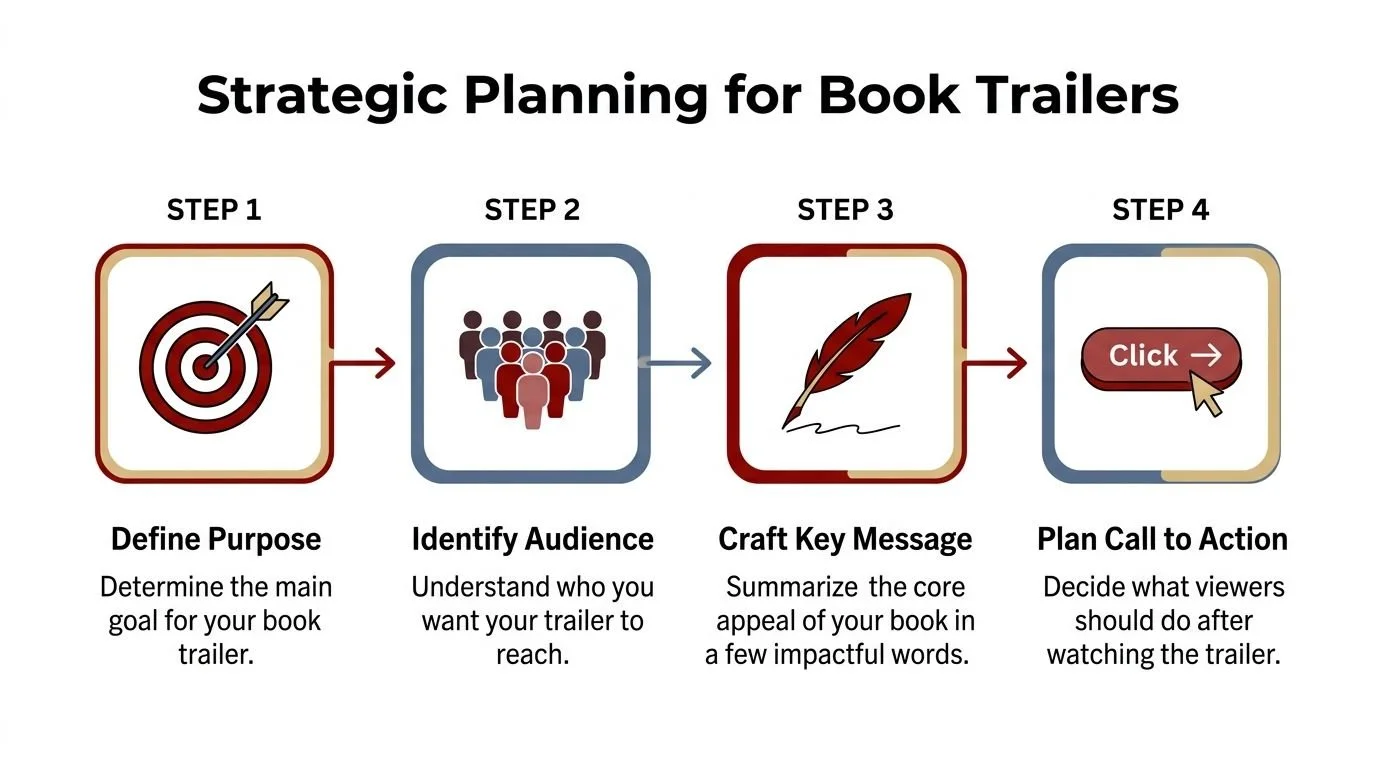
Start with one marketing objective
Choose one primary job for the trailer.
Not three. One.
Common goals include:
Launch support
You want a polished asset for release week, retailer pages, and social posts.Pre-order momentum
You need interest before the book is available, so the trailer should build curiosity and point clearly to the pre-order page.Mailing list growth
The trailer’s call to action should send viewers to a landing page with a sample chapter or bonus.Author brand building
This matters if you’re writing in a series or building a long-term platform.
If you can’t state the purpose in one sentence, you’re not ready to produce.
Match the trailer to the reader, not your manuscript notes
Authors often script trailers around what they know about the manuscript. Readers don’t need that level of context yet.
They need a fast answer to four questions:
What kind of book is this
Who is it for
What emotional experience does it promise
What should I do next
A memoir trailer should not sound like a thriller. A children’s picture book trailer should not use the pacing of a business book promo. The strongest trailers for books respect genre signals the same way a good cover does.
Your trailer should feel like the book a reader wants to buy, not the production process you want to describe.
Set a budget that fits the job
Budget has to follow objective. If you’re making a trailer for a single launch post and one Amazon listing, keep the scope tight.
If you want multiple cuts, voiceover, captions, retailer-ready versions, and platform-specific formats, production complexity rises quickly. In practice, a lot of authors do well in the $300 to $1,500 range, especially when the concept is disciplined and the distribution plan is real.
Keep these trade-offs in mind:
Lower budgets usually work best for text-driven trailers, still imagery, simple motion, and strong sound.
Mid-range budgets can support custom editing, better pacing, cleaner typography, and a more polished audio mix.
Higher budgets only make sense when you already know where the trailer will live and how it will be used repeatedly.
Adobe Premiere Pro is still a solid option if you’re comfortable editing. If you’re not, paying for cleaner execution is often the smarter move than spending days learning transitions you shouldn’t be using anyway.
Scripting and Storyboarding Your Book Trailer
The trailer script should be shorter than most authors think. If it reads like an excerpt, it’s too long. If it sounds like ad copy, it’s too stiff.
A workable trailer usually starts with a sequence, not a speech. You’re arranging tension, promise, and pacing.
Use a four-part trailer structure
This format works across fiction, memoir, and many nonfiction categories.
Hook
Open with a line or image that creates immediate interest.
That might be a question, a stark statement, or a single emotional premise. It should create tension fast.
Examples of hook styles:
Question-based: What would you risk to uncover the truth?
Statement-based: She vanished before sunrise.
Promise-based: A business book for founders who are tired of vague advice.
Premise
Give just enough context for the viewer to orient themselves.
At this stage, many scripts over-expand. Keep it skeletal. One character, one setting, one core situation. That’s enough.
Conflict
Now sharpen the central problem.
Conflict is what gives the trailer movement. For fiction, that might be danger, secrecy, loss, betrayal, or urgency. For nonfiction, it might be a painful business problem, a career turning point, or a specific transformation the reader wants.
Call to action
End with one instruction.
Use a concrete action such as pre-order now, read the sample, join the launch list, or visit the author website. Don’t stack options.
Strong trailers for books create curiosity first and clarity second. They don’t try to explain everything.
Keep visuals simple and specific
A useful storyboard can be rough. Boxes, timing notes, image references, and text placement are enough.
What matters is alignment between the script and the visual choices.
A notable example comes from research on The Hunger Games. In a study discussed in Davila’s analysis in ALAN, 95% of participants wanted to read the book after viewing its text-based trailer. The trailer relied on text and music rather than expensive visuals. That’s a useful reminder for indie authors. Mood and expectation often matter more than cinematic ambition.
Good storyboard ingredients include:
Cover reveal timing: Don’t show the cover for a split second. Let it land.
Text rhythm: Short bursts beat dense paragraphs.
Visual consistency: If you use stock, keep colour palette, lighting, and style coherent.
Readable typography: Fancy fonts often collapse on mobile.
If your book is part of a broader platform, visual consistency should carry across your cover, website, author headshots, and trailer design. That’s the same logic behind a recognisable author presence, and it’s explored well in this piece on building a recognisable author brand with great design.
Producing Your Trailer DIY vs Hiring a Pro
Production is where many authors overspend on the wrong thing or underspend on the only thing that matters. The decision usually comes down to time, skill, and tolerance for revision.
Both routes can work. They just solve different problems.
When DIY makes sense
DIY is sensible when the concept is straightforward and you already have the core assets.
That usually means:
a clear script
a clean cover file
usable still images or licensed stock
confidence with editing software
enough patience to revise pacing several times
Adobe Premiere Pro is a common choice if you want more control over timing, text animation, and audio. Simpler drag-and-drop tools can work for very basic text-and-image trailers, but they often become frustrating once you need cleaner typography, captioning, or multiple output formats.
DIY tends to work best for minimalist trailers, which fits the benchmark guidance that minimalist trailers often outperform flashy ones, and that watch completion drops by 70% for trailers longer than one minute in this book trailer marketing benchmark reference. That’s one reason a simple, disciplined concept often beats a more ambitious but uneven execution.
When hiring a pro is worth it
Professional help pays off when any of the following are true:
Your book depends on visual credibility
This applies to children’s books, illustrated books, premium nonfiction, and polished brand-driven titles.You need speed
A freelancer or studio can often move faster than an author learning the production process mid-launch.You want stronger audio and pacing
Professional work becomes evident here.You need multiple versions
Horizontal, square, vertical, captioned, and retailer-ready cuts add labour quickly.
A useful brief for a freelancer should include the book title, subtitle, genre, target reader, one-sentence premise, preferred runtime, sample trailers you like, visual references, brand colours if relevant, your chosen call to action, and all required deliverables.
Book trailer budget tiers
Here’s a practical way to think about production range.
| Budget (CAD) | What You Get | Best For |
|---|---|---|
| $300 to $500 | Text-based trailer, simple editing, stock imagery or supplied stills, basic music bed | Debut authors testing trailers for books without a large campaign |
| $500 to $900 | Stronger pacing, cleaner motion graphics, more polished typography, better audio edit, multiple revisions | Most indie launches that need a professional-looking core asset |
| $900 to $1,500 | Custom creative direction, more tailored editing, voiceover options, multiple format exports, launch-ready package | Authors with a clear distribution plan and several uses for the trailer |
The key isn’t spending more. It’s matching the spend to the likely return and avoiding complexity that won’t show up on screen.
Mastering Audio Voiceover, Music, and Licensing
If a trailer feels flat, the audio is usually the culprit. Viewers will forgive simple visuals faster than they’ll forgive weak sound.
A good music choice or a well-cast voiceover does more heavy lifting than many authors realise.
Choose the audio spine first
Start by deciding whether the trailer needs:
Music and text only
Voiceover plus music
Voiceover only
For many trailers for books, music plus on-screen text is enough. It keeps costs lower and avoids the risk of a poorly delivered narration.
Voiceover works best when the book’s tone depends on personality. Memoir, narrative nonfiction, and some children’s titles often benefit from a human voice. But the voice has to fit the book. A mismatched read can make a serious title sound theatrical or a warm title sound cold.
The strongest audio element is often the simplest one. A well-paced cue with the right emotional arc can carry an otherwise minimal trailer.
Audio sticks. Overdesigned visuals rarely do.
Avoid licensing mistakes that can derail release plans
Music licensing is where authors get sloppy. They assume a track is “royalty-free” and stop checking the usage terms.
You need to confirm that the licence covers commercial promotional use, platform uploads, and any edits or distribution versions you plan to create. Keep copies of licence receipts and file names in one folder. If a freelancer sources music for you, ask for the exact licence documentation.
The same principle applies to sound effects, voice talent agreements, and stock media rights. Get it in writing.
If you’re already thinking about sound as part of a broader reading experience, this article on enhancing ebooks with audio through cost-effective strategies for thoughtful authors is a useful companion.
A few practical audio checks before export:
Listen on phone speakers: That’s where many viewers will hear it.
Check voice clarity: Music should support the narration, not compete with it.
Keep levels consistent: Sudden jumps in volume feel amateur.
Add captions even if you have voiceover: They improve accessibility and help on silent autoplay platforms.
Distribution and Promotion Tactics for Your Trailer
A trailer with no distribution plan is just another file on your desktop. Promotion decides whether the trailer becomes useful.
Through promotion, trailers for books start behaving like real marketing assets instead of vanity projects.
A Canadian angle matters here. According to a 2025 BookNet Canada report cited in this discussion of visually compelling book trailers, self-published titles with video promos like trailers achieved 28% higher click-through rates on their Amazon.ca listings. That doesn’t mean every trailer performs well. It does mean discoverability can improve when video is handled properly.
Build platform versions on purpose
Don’t upload one master file everywhere and hope for the best.
Different placements need different versions:
Amazon.ca and website use: Cleaner, brand-forward, often horizontal.
Instagram Reels and TikTok: Vertical framing, larger text, faster opening.
Facebook and LinkedIn: Captions matter because many viewers watch without sound.
Email and newsletter promotion: Use a thumbnail linked to the trailer landing page or retailer page.
A trailer also needs a title and description that help the right people find it. Include the book title, genre cue, and author name. Keep descriptions plain. Avoid keyword stuffing.
Use the trailer where buying decisions happen
The smartest place for your trailer isn’t always social media.
Often it’s the places where a reader is already evaluating the book:
Your author website homepage
The individual book page
Retailer-linked landing pages
Newsletter announcements
Media kits for podcasts, reviewers, or event hosts
If you’re building a broader visibility plan, this guide on getting your book in front of readers is worth reviewing alongside your trailer rollout.
One more operational note matters for Canadian authors. If you plan to use the trailer widely, prepare the captioned version early, not at the end. Distribution gets messy when every platform needs a slightly different file and you’re still fixing text overlays two days before launch.
Frequently Asked Questions About Book Trailers
Are book trailers worth it for self-published authors
Yes, if you use them to improve discoverability, reinforce interest, and support launch materials. They’re less useful when treated as a standalone sales engine. The value comes from how well the trailer fits your book, your audience, and your distribution plan.
How long should a book trailer be
For most indie authors, short is better. The benchmark guidance cited earlier supports a brief runtime, and in practice the strongest trailers for books usually stay focused, move quickly, and end before the viewer feels they’ve seen too much.
Do I need expensive visuals to make a good trailer
No. Expensive visuals can help, but they aren’t the deciding factor. Strong pacing, clear text, suitable audio, and a coherent visual style matter more than flashy effects. A simple trailer can outperform a busy one if it creates the right expectation.
What should a book trailer include
A solid trailer usually includes:
A hook: Something that creates immediate curiosity.
A clear premise: Just enough context to orient the viewer.
A sense of conflict or promise: Why this book matters.
The cover and author name: Let the viewer remember what they saw.
One call to action: Pre-order, buy, read a sample, or visit the website.
Do Canadian authors need captions on book trailers
In many cases, yes. Accessibility is not optional if you want broad platform compatibility and fewer distribution issues. A 2025 Statistics Canada report noted that 22% of Ontario self-publishers faced platform rejections for non-compliant videos, often due to missing accessibility features like closed captions required by AODA, as referenced in this article discussing book trailer pitfalls.
If your trailer will be used in Canada, build captions into the workflow from the start. Don’t treat them as a final extra.
Where should I post trailers for books
Post them where readers are already interacting with your book. That usually includes your author website, the book page, launch emails, retailer-linked pages, and selected social platforms. Choose placements based on your audience rather than trying to be everywhere at once.
If you want expert help creating a trailer that fits your book, your budget, and your launch plan, Foglio Publishing is a smart place to start. Their Canada-based team helps authors produce market-ready books and polished promotional assets that respect both creative standards and distribution realities.
