
How to Choose Book Excerpt: An Actionable Author’s Guide
You’re probably staring at a manuscript and asking a deceptively simple question. Which passage should represent the whole book without giving away too much, confusing new readers, or falling flat on the wrong platform? The short answer is this: choose a passage that stands on its own, introduces tension quickly, matches the channel where it will appear, and leaves the reader wanting the next page. That’s the core of how to choose book excerpt well.
A strong excerpt isn’t always your opening pages. In practice, the best-performing passages are often the ones where the stakes sharpen and the voice is already fully alive. For web previews, I often favour a longer sample when the goal is immersion. For social posts, newsletters, press kits, and audio teasers, the better move is to package different versions of the same book for different jobs.
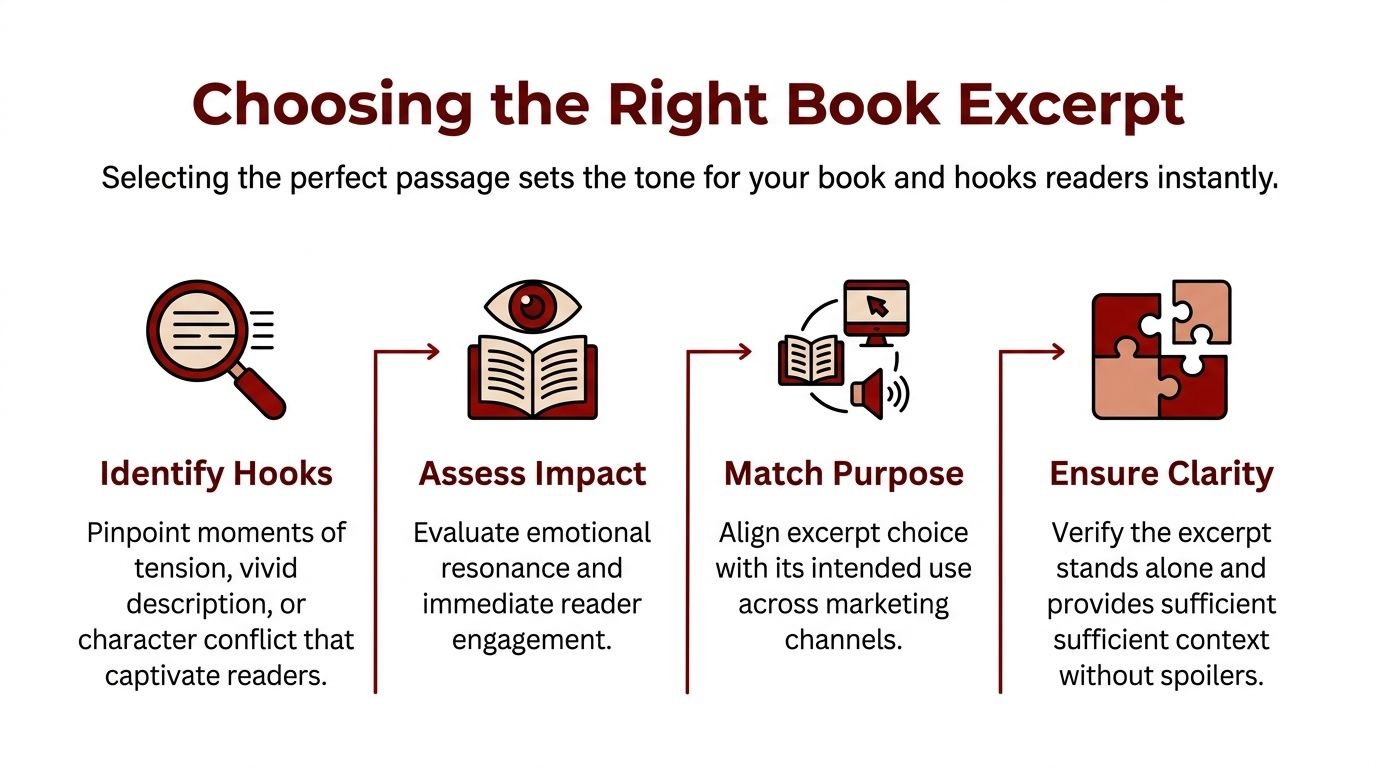
Choosing the right book excerpt
Most authors start with the first chapter because it feels safe. It usually isn’t the best choice.
Openings often spend time orienting the reader. That works inside the full book, but it can underperform as marketing. A promotional excerpt has to create immediate forward motion.
Start by rejecting the obvious weak choices
Rule out passages that need too much explanation. If a reader has to know who three side characters are, remember an earlier reveal, or understand a complicated timeline before the scene lands, skip it.
The same goes for excerpts that spoil the book’s central turn. Curiosity drives sampling. Explanation kills it.
According to IngramSpark’s guidance on choosing the perfect book excerpt, 200-500 word excerpts on author websites and social media can boost reader engagement by up to 35% when they work as standalone teasers.
Three excerpt types usually survive the first cut:
Conflict scenes: An argument, decision, confrontation, or moment of real pressure.
Voice-led passages: A memoir insight, sharp observation, or opening of a chapter where the author’s tone is unmistakable.
Revelation without resolution: A point where the reader learns something meaningful but still needs the next section.
Practical rule: If the passage needs a paragraph of setup before it makes sense, it’s not ready.
Mid-book scenes are often stronger than prologues or chapter ones because the voice has settled and the stakes are clearer. That matters especially for memoir and nonfiction, where the best excerpt is often the moment the book stops introducing itself and starts making a real argument or emotional turn.
Use a simple selection test
When I’m narrowing an excerpt shortlist, I use four questions:
Would this make sense to someone who has never seen the book before?
Does something change inside the passage?
Can the reader hear the book’s real voice here?
Does it stop at a point that creates pull?
If a passage fails even one of those, it usually needs replacing or trimming.
For web previews, many authors find that a longer sample works well when they need enough room to establish tone and stakes. In practice, 1,500-3,000 words can work when the excerpt is immersive and the pacing holds. That’s especially useful on author sites, lead magnets, and reviewer packs. The trade-off is obvious. The longer the sample, the more disciplined the passage has to be.
A useful final check is to hand two or three options to outside readers with minimal framing. If you need help structuring that feedback, a practical reference is this guide to what a beta reader does for authors. Ask simple questions like: Where did your attention rise, where did it drift, and would you keep reading?
Editing and formatting excerpts for print web and audio
Choosing the scene is only half the job. The packaging changes how the excerpt feels.
A passage that reads beautifully inside a book can stumble when pulled into a press kit, email, EPUB sample, or spoken audio clip. Tight editing fixes that.
Edit for independence, not perfectionism
Your goal isn’t to rewrite the book. Your goal is to remove friction.
That usually means:
Trim context references: Cut lines that depend on earlier scenes.
Smooth names and identifiers: If two pronouns in a row create confusion, replace one with a name.
Remove dead lead-in: Start closer to the turn, conflict, or insight.
Keep the original voice: Don’t polish the life out of it.
For media outreach and email campaigns, longer samples can do more work. Books Forward’s article on what makes a good book excerpt notes that 750-1000 word excerpts for media exclusives correlated with a 52% uplift in pre-orders among nonfiction creators.
That range is useful because it gives enough space for setup, movement, and a strong stop point. It’s long enough to feel substantial, but short enough to remain purposeful.
Keep annotations minimal. A couple of guiding questions for beta readers or reviewers is enough. If you over-explain the passage, you distort the feedback.
Choose file types by use case
For reviewers, I usually send both EPUB and PDF.
EPUB is better for natural reading. It flows cleanly on phones, tablets, and e-readers. PDF is better when layout consistency matters, especially for illustrated pages, fixed formatting, or author-approved design.
A basic format decision looks like this:
| Use case | Best format | Why |
|---|---|---|
| Reviewer reading copy | EPUB | Feels closest to normal digital reading |
| Press kit excerpt | Preserves layout and page breaks | |
| Retail-ready digital sample | EPUB | Better for eBook ecosystems |
| Internal approval round | PDF + doc file | Easy to mark and compare |
For audio previews, don’t read the page as-is if the syntax is visually elegant but hard to hear. Read it aloud and cut any sentence that tangles. Spoken excerpts need clear cadence, fewer nested clauses, and clean transitions.
If you’re still refining your production workflow, this breakdown of formatting and typesetting tools for self-publishing authors is a helpful companion.
Securing permissions and handling copyright
Many excerpts are legally simple because they come from your own manuscript. The problems start when your passage includes borrowed material.
That can mean song lyrics, epigraphs, long quotations, reproduced letters, photographs, screenshots, poems, or translated text. Even a short excerpt can trigger a permissions issue if it contains protected material.
Know what needs clearance
Ask these questions before you circulate anything publicly:
Did you write every line in the excerpt yourself?
Does the passage include a quote from another work?
Are there lyrics, poems, or image references embedded in the text?
Did someone else supply a testimonial or letter that appears in the sample?
If the answer raises doubt, pause and verify rights before distribution.
Fair dealing may apply in some contexts in Canada, but authors get into trouble when they assume promotional use automatically counts as permitted use. It doesn’t always. Marketing is a separate context from scholarship, criticism, or private study.
Build a permissions trail
Handle permissions like production paperwork, not like a casual email thread.
Create a simple record with:
Rights holder name
Work being used
Exact text or asset requested
Territory and language
Format such as print, eBook, audio, web
Approval status
Licence terms or fee notes
A clean permissions file saves frantic last-minute edits when a reviewer copy is ready to go but one quoted line still isn’t cleared.
If permission is denied or delayed, replace the material early. Don’t build a launch asset around text you may have to remove later.
Packaging excerpts for marketing channels
An excerpt that works in a newsletter often fails in a press kit. The writing may be strong in both places, but the packaging does different work.
A subscriber opens on a phone and decides in seconds whether to keep reading. A journalist scans for context, metadata, and a clean pull quote. An audio listener needs a passage that sounds finished when spoken aloud. Treat the excerpt as one asset with several versions, each built for a specific use.
Treat each channel as a different reading environment
Packaging changes response.
I regularly see authors send the same two-page sample to subscribers, reviewers, media contacts, and audiobook prospects. It saves time at first, then creates avoidable drag. The email version feels too long. The press version lacks basic book details. The audio version includes lines that read well on the page but sound flat out loud.
Build a small excerpt set instead of one master file. In practice, that usually means choosing one core passage, then adapting it for three to five channels.
A practical setup looks like this:
Newsletter excerpt: Run the sample in the email body or on a linked landing page. Keep the opening tight, preserve the emotional turn, and end with one next step such as pre-order, reply, or download.
Press kit excerpt: Package it as a clean PDF with title, subtitle, author name, genre, pub date, ISBN if assigned, rights information, and a short author bio. Make it easy for a publicist or editor to lift approved material without asking basic follow-up questions.
Website sample: Match the excerpt length to the page goal. A homepage teaser should be brief. A dedicated sample chapter page can carry more text if the page is meant to qualify interested readers.
Social teaser: Pull one sharp beat from the longer excerpt. A single line, short paragraph, or carousel slide usually performs better than a dense block of text.
Audio preview: Use a passage with spoken rhythm, clear sentence endings, and minimal visual reference. If a line depends on typography, footnotes, or page layout, rewrite or replace it.
The trade-off is simple. More versions mean more prep time, but they also give each channel a better chance to do its job.
Marketing channels excerpt format guide
| Channel | Format | Ideal excerpt length | Notes |
|---|---|---|---|
| Author newsletter | Email body or linked landing page | Long enough to create momentum | End on an unresolved point and include one clear call to action |
| Author website | Embedded page text or downloadable sample | Short web teaser or longer immersive preview | Match the page goal. Discovery pages need speed, dedicated sample pages can carry more text |
| Press kit | Substantial but selective | Add title, ISBN if available, contact details, and usage notes | |
| Reviewer copy | EPUB and PDF | Longer sample or full approved extract | EPUB improves readability, PDF preserves intended formatting |
| Social media | Caption plus image slide or linked page | Very short | Use one hook, not a full scene |
| Audio preview | Narration script | Short spoken segment | Trim visual-only phrasing and rehearse for cadence |
One packaging habit pays off across all of these channels. Keep a simple folder with clearly named files such as newsletter_excerpt, press_excerpt, audio_preview_script, and website_sample. That prevents version mix-ups during launch week and makes handoff easier if a designer, assistant, or publicist joins the project.
If you’re also mailing early copies, this guide to advance reader copies and early launch visibility helps connect excerpt packaging to the broader launch schedule.
Measuring excerpt performance
You can’t tell which excerpt works by instinct alone. You need to watch what readers do next.
Performance depends on the job. A social teaser should earn clicks. A newsletter sample should drive replies, sign-ups, or pre-orders. A retailer preview should push readers deeper into the book page.
Track the behaviour that matches the channel
Don’t lump all results together. Track one primary action per placement.
Useful measures include:
Click-through rate for social posts and short teaser pages
Sign-up rate for newsletter landing pages
Reply quality from reviewer and beta outreach
Pre-order movement after email or media campaigns
Scroll depth or read-through on dedicated excerpt pages
For marketplace links and short promotional teasers, brevity often wins the first click. MK Marketing Services’ guide to short vs long book excerpts reports that 100-300 word excerpts achieved a 25% higher click-through rate to full book pages on platforms like Amazon.ca and Kobo.
That doesn’t mean every excerpt should be short. It means short copy often performs better when the reader’s next step is a click rather than a sit-down read.
Run small tests before you commit
Test two variables at a time, not six.
A simple sequence works best:
Choose two excerpt candidates that differ in tension or tone.
Keep the headline and design constant so the excerpt is the true variable.
Send each version to a comparable audience segment.
Review the next action, not just open rates or impressions.
Promote the winner into larger channels.
The strongest excerpt is rarely the most beautiful paragraph in the manuscript. It’s the one that changes reader behaviour.
UTM links, email platform reports, and basic landing-page dashboards are enough for most indie launches. You don’t need a complicated analytics stack to learn what’s working. You need clean comparison and a clear definition of success.
Next steps for using book excerpts
If you want a working system for how to choose book excerpt assets, don’t stop at picking one passage. Build a small excerpt set.
Choose two short excerpts, one medium-length media sample, and one longer immersive preview. Assign each one to a specific channel. Then test them over a few weeks instead of launching everything at once on the same day.
Keep a simple tracking sheet. Note where each excerpt appears, what action it asks for, and how readers respond. Revise lightly, not endlessly. Most excerpt problems come from poor selection or poor packaging, not from a missing adjective.
The authors who use excerpts well treat them as ongoing marketing tools, not one-off launch materials.
FAQ
What is the best excerpt to choose from a book?
Choose the passage that creates immediate curiosity, sounds like the book, and leaves the reader wanting the next page. In practice, that is often a scene with a clear question, a shift in stakes, or a strong emotional turn. The opening chapter can work, but many authors get better results from a later section that reaches the point faster.
How long should a book excerpt be?
Length should match the job.
A newsletter excerpt usually needs to be short enough to read in one sitting and strong enough to earn a click. A press kit excerpt can run longer if it gives media contacts enough substance to quote or assess. Audio previews need even tighter pacing because listeners drop off faster when setup runs long. Website samples can stretch further, as long as the excerpt keeps momentum and ends at a natural stopping point.
Should I use the first chapter as my excerpt?
Use it only if it performs well as a sales sample. Some first chapters are built to orient the reader, establish setting, or introduce background. That can work in the book and still fall flat in marketing. An excerpt has less room to warm up.
What format should I send to reviewers?
PDF and EPUB cover the usual reviewer needs. PDF keeps layout stable for print-oriented coverage and press use. EPUB is easier to read on phones, tablets, and e-readers.
If you are sending an audio sample to podcasters, radio producers, or bookstagrammers who post reels, include a clean MP3 with the filename clearly labelled. Packaging matters. A good excerpt loses value when the file arrives in the wrong format for the channel.
Can I edit an excerpt for marketing?
Yes, with restraint. Trim slow setup, remove references that confuse a new reader, and fix transitions if a cut creates a rough edge. Keep the voice, pacing, and tone consistent with the full book.
I usually advise authors to edit for clarity, not to rewrite for effect. If the excerpt sounds sharper than the book, readers will notice.
Do I need permission to use quotes inside my excerpt?
You may. Lyrics, poems, letters, images, and extended quotations from other works often require permission before public use. Promotional intent does not automatically protect you.
Check the excerpt line by line before it goes into a newsletter, media kit, retailer sample, or audio script. Rights problems often show up at the packaging stage, not during drafting.
How do I know if an excerpt is working?
Judge it by the action tied to that placement. A website excerpt should hold attention and lead to a sample download, retailer click, or sale. A newsletter excerpt should earn clicks or replies. A press kit excerpt should help secure coverage. An audio preview should keep listeners engaged long enough to reach the call to action.
Test one variable at a time. Keep the audience, channel, and offer consistent, then compare excerpt A against excerpt B. That gives you something useful to act on.
Foglio Publishing helps authors turn strong manuscripts into market-ready books with editing, design, formatting, eBook production, print, and distribution support suited to Canadian self-publishing. If you want experienced help choosing, polishing, and packaging excerpts that fit your launch channels, explore Foglio Publishing.
