
Printed Books on Demand: A 2026 Author's Guide
Printed books on demand are pitched as the easiest way to publish a paperback. That framing causes problems early, because POD is less of a shortcut and more of a set of positioning choices that shape the book you end up selling.
A POD book is printed only after a customer order comes in, which makes it a practical option for authors who do not want to fund a warehouse of inventory or guess at a first print run. That convenience makes book selling more accessible for new authors, but that’s not all.
Authors need to decide what standard of object they want to put into the market, what margins they can live with, how widely they want the book distributed, and how carefully they will prepare the files before upload.
Trim size affects genre fit and unit cost. Paper and cover finish affect how the book feels in hand. Metadata affects whether readers can find it at all. File prep affects whether the printed copy looks clean or amateur. We cover that broader print standard in our guide to why print quality still shapes how readers judge a book.
First-time authors often assume POD quality is decided by the printer alone. In practice, the printer only executes the package it receives. A well-prepared POD title can look fully professional and sell confidently in its category. A rushed one usually reveals weak typography, poor cover setup, thin margins, or preventable production errors.
That is why POD works best when authors treat it as a publishing strategy, not just a production method. Professional guidance helps at the points where beginners usually lose quality, margin, or distribution without noticing until the book is already live.
What Are Printed Books on Demand
Printed books on demand are books printed one order at a time from approved digital files. A copy is manufactured only after a reader buys it, or after the author orders copies for review, events, or direct sales.
That changes the author's first big decision. Instead of guessing demand and paying for a full print run up front, you choose flexibility. You can test the market, correct files between printings, and avoid tying up cash in boxes of books that may sit untouched.
POD has grown for that reason, and the growth is expected to continue. Analysts project a larger POD market in 2025, with steady use among self-published authors in Canada and the U.S., because the model lowers inventory risk and keeps titles available longer. The exact numbers matter less than the business logic. POD reduces exposure, but it also asks the author to accept tighter production constraints.
That is why I do not frame POD as a printing shortcut. It is a positioning choice.
POD is a strategy, not just a print method
Every POD decision signals something about the book. Trim size affects how the book sits beside competing titles. Paper choice affects whether a photo book feels premium or flat. Retail distribution affects margin. File prep affects whether the finished copy looks professional or self-made in the wrong way.
Some books need broad availability and low overhead. Others need stronger print presence, better colour handling, or more control over materials. POD can support both aims up to a point, but it rarely hides weak preparation.
Practical rule: Treat POD like a publishing format with fixed standards, and the book usually performs better in the market and in the reader's hands.
Authors get the best result when they decide early what the book needs to do. Sell widely through online retail. Support a consulting business. Serve as a premium leave-behind. Validate an idea before investing in offset. Those are different jobs, and they lead to different production choices.
For context on why print still carries weight for readers and buyers, Our article on the primacy of print is a useful starting point before you choose your POD path.
How the Print on Demand Workflow Works
The easiest way to understand printed books on demand is to compare the process to an automated kitchen. You don't hand a chef a rough idea and hope for the best. You submit a finished recipe in the exact format the kitchen expects. If the recipe is clean, the meal comes out fast. If it isn't, the system stalls.
The order starts with your files
A POD workflow begins with two core files:
Interior PDF: This contains the book's pages in final print form.
Cover PDF: This includes the front cover, spine, back cover, and bleed.
Metadata entry: Title, author name, ISBN, description, categories, and pricing.
Platform setup: This often happens inside Amazon KDP, IngramSpark, or another print-distribution system.
Once uploaded, the platform runs an automated check. It looks for obvious production problems such as wrong page size, low-resolution images, missing bleed, or font issues. If the files don't meet spec, the job gets flagged or rejected.
This is why authors who assume POD is flexible often get frustrated. The system is efficient because it is rigid.
The printer follows a fixed system
When a customer places an order, the platform sends the approved files into a digital production workflow. The book is printed, trimmed, bound, packed, and shipped with very little manual intervention.
That speed is one of POD's biggest strengths. It also explains why file precision matters so much. The press isn't making interpretive choices. It is producing exactly what your files tell it to produce.
A clean workflow usually looks like this:
Upload final files
Pass automated pre-flight
Approve proof
Open distribution
Receive orders
Print and ship each copy on demand
A surprisingly good POD result usually comes from removing variables, not adding them.
That shows up in practice all the time. Standard trim sizes, standard paper choices, embedded fonts, and properly converted print files tend to move through the system more smoothly than custom-looking setups that weren't prepared properly.
If you're still sorting out technical requirements before upload, this guide to print-ready book files helps authors understand what the printer needs.
Quality and Practicality The Pros and Cons of POD
POD is often sold as the easy publishing option. In practice, it rewards authors who make disciplined choices early.
The quality question is usually framed the wrong way. POD is not "good" or "bad." It performs well when the book's purpose, format, and production choices match what digital printing handles reliably. It starts to disappoint when an author expects low upfront risk, low unit cost, premium materials, perfect colour control, and strong retail compatibility all at once.
Where POD works very well
POD is a strong fit for books that need to stay available without tying up cash in inventory. That makes it especially useful for many memoirs, nonfiction titles, professional books, and first releases.
Its advantages are practical:
Low inventory risk: Copies are printed as orders come in, so you are not paying for a large run before demand is proven.
Useful for testing: Authors can review sample copies and catch issues before pushing wider distribution.
Broad platform access: Services such as Amazon KDP and IngramSpark make it possible to list a book for sale without warehousing stock.
Good match for standard trade books: Conventional trim sizes and straightforward interiors tend to translate well to POD.
For many first-time authors, that is enough. The immediate goal is usually a book that looks professional, reads cleanly, and can be ordered easily.
A standard black-and-white paperback often does very well here. If the typography is solid, the cover is prepared correctly, and the files are built to spec, POD can produce a book that meets reader expectations and supports a serious launch.
Where POD can disappoint
POD becomes less forgiving when the book depends on materials or print characteristics that need tighter control.
Illustrated books, art-heavy projects, colour-sensitive children's titles, and books meant to signal luxury are the usual pressure points. Acutrack's discussion of POD trade-offs makes the broader point clearly: print-on-demand offers flexibility, but that flexibility comes with limits in colour consistency, substrate options, and finishing.
Those limits show up in ways first-time authors do not always expect. Skin tones may shift slightly between runs. Dark covers can show surface wear more easily. Paper choices are narrower than in custom print manufacturing. A book can still be perfectly readable and saleable while falling short of the polished feel an author had in mind.
That distinction matters.
A memoir printed on cream stock in a standard trim size can look excellent in POD. A colour-heavy picture book that depends on delicate tones and a premium tactile impression asks much more from the process.
The most common mistake is trying to get premium feel, maximum flexibility, and the lowest possible cost in the same POD setup.
The most important trade-off is positioning
The best POD decision starts with market position, not machinery.
Ask what the book needs to do. If its role is broad availability, backlist sales, lead generation, course support, or a first market test, POD is often the right production model. If the book has to carry a premium brand, justify a higher cover price at events, or impress buyers the moment they pick it up, production choices need closer control.
That does not automatically rule out POD. It means the format, paper, cover finish, and interior design have to stay within what POD can reproduce consistently. Authors who ignore that usually blame the printer for a decision problem that started much earlier.
Professional preparation makes a visible difference in this context. Strong file setup, sensible specifications, and realistic production choices separate a POD book that merely functions from one that feels considered. Foglio Publishing supports authors with that planning work, including formatting, ISBNs, distribution setup, and choosing between POD and custom print paths.
POD vs Offset Printing A Practical Comparison
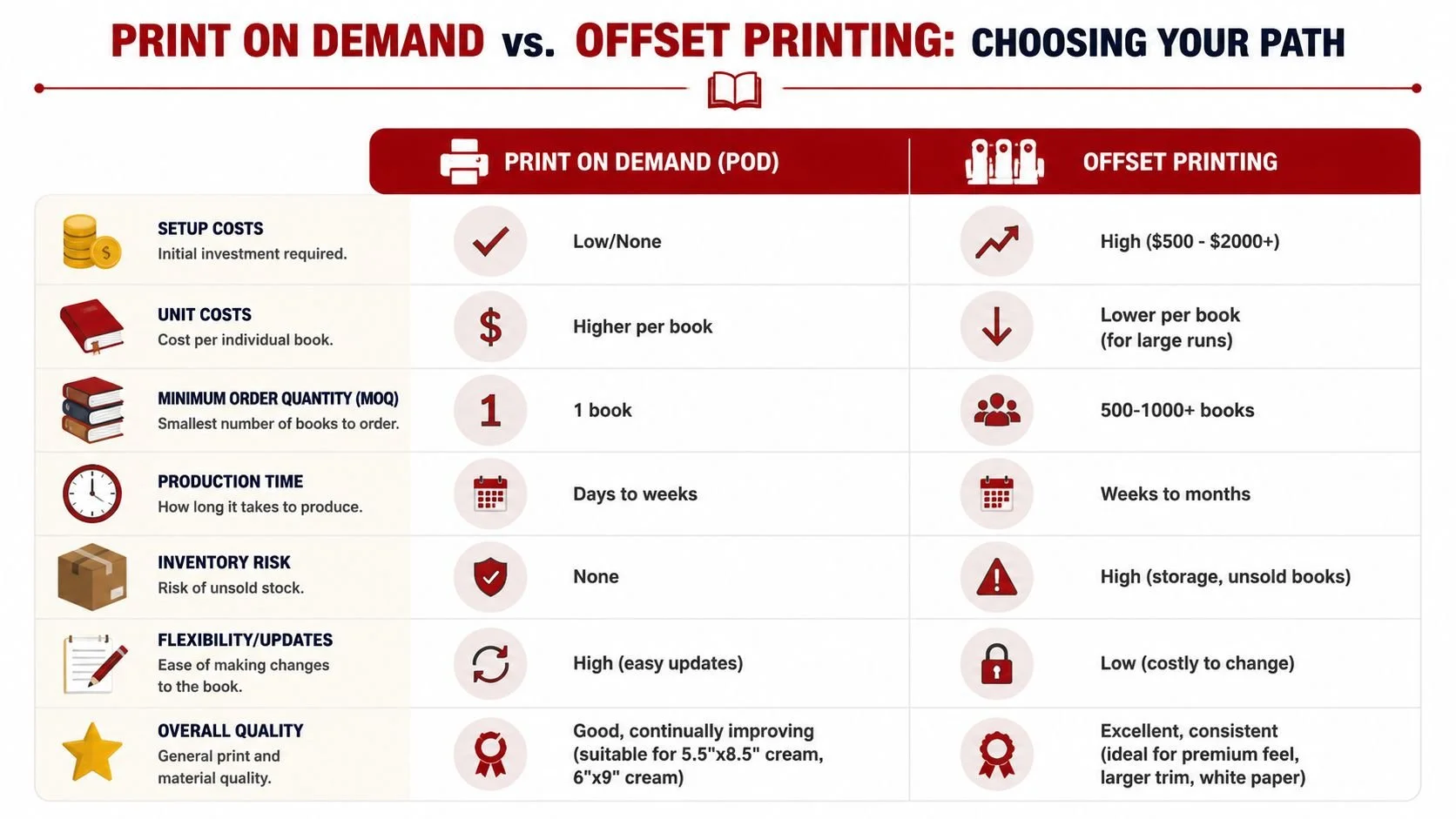
The biggest mistake authors make here is treating POD and offset as quality labels. They aren't. They are production models with different economics, timelines, and risks.
The main economic break point
The clearest dividing line is volume.
According to Bookmundo, print-on-demand is most cost-effective up to approximately 300 copies. Beyond that point, offset printing usually becomes the better option. POD keeps a roughly constant per-unit cost from 1 copy to 300 copies, while offset becomes more efficient as volume rises.
That single fact answers most early printing questions.
If you're launching a first book and don't know your demand, POD protects your cash and avoids boxes of unsold books.
If you already have committed sales, event demand, institutional orders, or a clear reason to print at scale, offset often gives you more control and better unit economics.
Print-on-Demand vs. Offset Printing at a Glance
| Factor | Print-on-Demand (POD) | Offset Printing |
|---|---|---|
| Best use case | First releases, uncertain demand, ongoing availability | Planned bulk runs, events, pre-sold inventory, premium projects |
| Cost structure | Constant per-unit cost across small quantities | Higher setup cost, but lower cost per unit as volume increases |
| Ideal quantity | Strong fit for low-volume orders and testing | Better fit once demand supports larger runs |
| Inventory | No storage required for retail fulfilment | Requires storage, handling, and stock management |
| Speed to market | Fast once files are approved | Slower to set up and produce |
| Revisions | Easier to update files between print cycles | Changes are more disruptive once printed |
| Material flexibility | More limited, especially for premium finishes | More control over paper, finishes, and physical feel |
| Colour consistency | Good for many books, less predictable for demanding visual work | Stronger consistency for premium and colour-sensitive projects |
| Risk profile | Lower financial risk up front | Higher financial commitment up front |
A simpler way to choose is to use these questions:
Do you know demand yet? If not, POD is safer.
Is your book mainly text? POD usually handles that well.
Is physical presentation the product? Offset deserves a closer look.
Do you need flexibility after launch? POD makes updates easier.
Are you crossing the 300-copy threshold? That's where offset often starts making more financial sense.
Offset rewards certainty. POD rewards flexibility.
Neither path is more "professional" on its own. The professional choice is the one that matches your book's actual use.
Preparing Flawless Files for On-Demand Printing
Most POD problems begin before printing starts. Authors blame the printer when the actual issue is the file.
A clean file doesn't guarantee a beautiful book, but a messy file almost guarantees trouble. If you've ever seen a blurry image, awkward gutter spacing, text creeping too close to the trim, or a cover with the wrong spine width, that's usually a preparation failure.
The file standards that matter
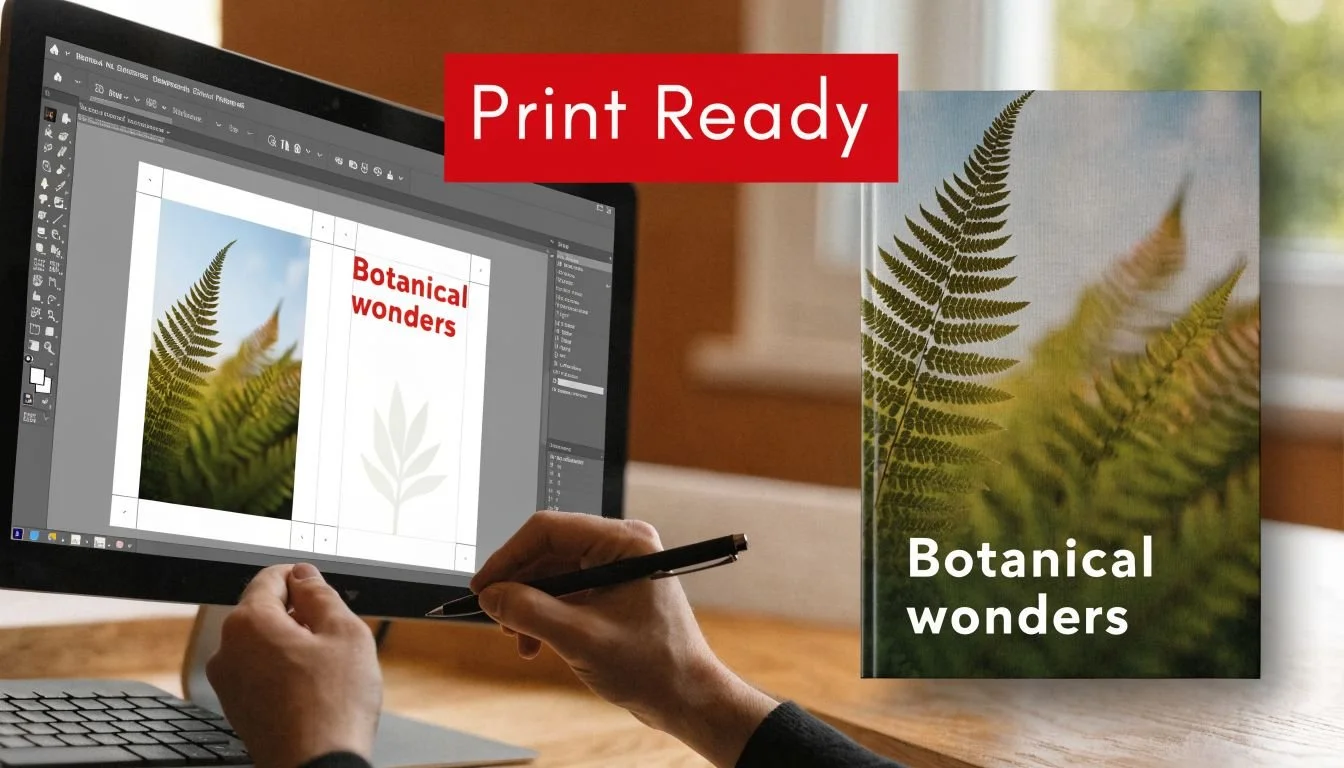
According to this technical overview of POD print specifications, POD publishers typically require 300 DPI image resolution, CMYK colour mode, and inside margins of at least 0.5 inches. The cover must be a separate single-page PDF that includes the front, back, spine, and bleed. Following these standards supports automated workflows that can meet 5-7 day delivery windows.
Those rules aren't arbitrary.
300 DPI keeps images sharp on paper.
CMYK matches how commercial presses print colour. RGB is for screens.
Proper margins protect readability and stop text from falling into the binding area.
A separate cover PDF lets the system process the full wrap correctly.
Many vendors also expect single-page interior PDFs rather than spreads. That's because the printer imposes pages for production. If you submit them the way you see a book open on your desk, the system has to fight your layout.
What usually causes delays and poor output
The same problems appear again and again:
Low-resolution artwork: It looked fine on screen, but prints soft or pixelated.
RGB images: Colours shift because they were never prepared for print.
Wrong trim size: The file doesn't match the actual product selected on the platform.
Missing bleed: Background colour or images stop short and leave unwanted edges.
Unembedded fonts: Text can reflow or substitute unexpectedly.
Weak spine setup: The cover doesn't match final page count and paper choice.
The best POD outcomes usually come from restraint. Standard trim sizes, genre-appropriate paper, and correctly built files tend to outperform ambitious layouts that push the process too hard.
Good POD quality rarely comes from luck. It comes from files that don't leave room for interpretation.
If you're not comfortable checking all of that yourself, get a professional formatter or typesetter involved before upload. It is cheaper than fixing a public launch with poor print samples already in circulation.
Distribution ISBNs and Getting Your POD Book to Market
A printed book isn't market-ready just because it can be printed. Readers have to be able to find it, retailers have to be able to list it, and Canadian publishing requirements still have to be met.
That is where many first-time self-publishers hit avoidable problems.
Canadian ISBNs and legal deposit are not optional
For Canadian authors, ISBN assignment and legal deposit need attention early, not after launch. Reports cited in this discussion of Canadian POD compliance say 68% of Canadian indie authors using POD fail their initial submissions to Library and Archives Canada due to formatting errors, and non-compliance with legal deposit can risk fines up to $5,000.
That matters because an ISBN is not just a barcode number in spirit. It is part of your book's identity in the supply chain. It affects cataloguing, retailer setup, and discoverability.
If your audience is in Canada, use the right ISBN path from the start. If you need a practical overview before you register or assign one, this guide to ISBNs for self-publishing authors covers the basics in plain language.
Metadata decides whether readers can find your book
Metadata sounds technical, but it is simple. It is the information that tells bookstores and online retailers what your book is.
That includes:
Title and subtitle: Clear and consistent across all platforms
Author name: Exactly the same everywhere
Book description: Written for readers, not just for you
Category selection: Close to the shelf where your reader would expect to find it
Keywords: Useful search terms that match actual reader behaviour
Format details: Trim size, binding, page count, and language
Poor metadata creates silent problems. The book may technically exist, but it won't present well in online stores. Or worse, details won't match from one system to another.
A clean market setup usually follows this order:
Finalise the title and subtitle
Confirm ISBN ownership and assignment
Prepare files that match the chosen format
Enter consistent metadata on every platform
Complete legal deposit requirements where applicable
Review your live retail listing carefully
Readers don't buy a file. They buy a listing, a promise, and then a physical object. All three need to align.
Your POD Publishing Checklist
Before you choose printed books on demand, answer these questions clearly.
What is this book trying to do? Is it built for broad distribution, low-risk testing, lead generation, or a premium brand experience?
Does POD fit the quantity? If your likely need is under the rough break point covered earlier, POD is often the practical option.
Does the format suit the genre? Standard nonfiction and memoir formats usually translate well. Colour-heavy books need more caution.
Are your files print-ready? Check resolution, colour mode, trim size, margins, bleed, fonts, and cover setup.
Have you ordered physical copies for review? Most authors feel more confident after checking several real copies in hand.
Is your ISBN plan correct for Canada? Don't leave assignment and compliance until the end.
Have you completed your metadata carefully? Retail listings need consistency more than cleverness.
Do you need flexibility or finish? If you need easy updates, POD has an edge. If physical polish is the main product, compare offset seriously.
A useful final filter is this: Are you trying to optimise for affordability and presentation at the same time? If so, decide which one matters more for this specific book.
That answer usually clears up the production path quickly.
Frequently Asked Questions About Printed Books on Demand
Can printed books on demand look professional?
Yes. They can look fully professional when the book suits the format and the files are prepared properly. Text-heavy books such as memoirs, nonfiction, and business titles often perform well in POD. Problems usually show up when the file prep is weak or the project depends on precise colour control and premium materials.
How many POD copies should an author order first?
Technically, one copy is enough. In practice, many authors start with 3 to 10 copies so they can check print quality, review the cover and spine, send advance copies to early readers, and keep a few for personal use. That first small batch is less about savings and more about confidence.
Is POD better than offset printing?
Not universally. POD is usually better for low-risk launches, uncertain demand, and flexible updates. Offset is usually better when you already know demand, want stronger control over materials, or need a more premium physical result at higher volume.
What is the most common POD mistake first-time authors make?
They treat file preparation as a minor technical step. It isn't. Poor image resolution, wrong colour mode, weak margins, and mismatched cover files can undermine the whole book. The cleaner the setup, the better the outcome.
Is POD a good choice for children's books?
Sometimes, but it needs care. Children's books and illustrated books are less forgiving because colour, paper, and visual consistency matter more. For those projects, proofing is critical, and some authors may decide that a different print method or a more guided production process makes better sense.
If you're weighing printed books on demand against a custom print run, or you're unsure whether your files and distribution setup are ready, Foglio Publishing can help you sort through the practical decisions. A clear production plan, proper formatting, and the right market setup usually make the difference between a book that merely prints and a book that's ready to sell.
