
How to Write a Novella: From Idea to Publication
Most advice on how to write a novella gets one thing wrong. It treats the novella like a smaller novel. That usually leads to either a padded short story or a rushed book that feels thin. A strong novella is its own form. It needs one central conflict, tight structure, fast pacing, and disciplined revision from the first page to publication.
If you're writing your first book, the novella is often the smartest place to start. It gives you enough room for a full emotional arc, but not enough room to wander. That limitation helps. It forces decisions. It also gives self-publishing authors a manageable project with a clear finish line.
What is a Novella? Defining the Form and Word Count

A novella is a form with its own demands
Many first-time authors treat a novella as a novel they can write faster. That assumption causes trouble early. A strong novella is built for compression from page one, with a single line of narrative force and very little room for drift.
The form rewards decisions. One central conflict. One primary emotional thread. A small cast that earns its place on the page.
That is why novellas so often feel sharper than weak novels and more complete than stretched short stories. They are not reduced versions of something larger. They are designed to deliver pressure, movement, and resolution without the extra architecture a full-length novel can carry.
According to Publishing Xpress on novella standards, a novella generally falls between 15,000 and 50,000 words. Below that range, a piece usually reads as a short story or novelette. Above it, readers and retailers often start treating the manuscript as a short novel.
Word count is a craft decision, not just a label
For a first novella, the formal range is less useful than the workable range. In practice, 20,000 to 40,000 words gives newer authors enough space to build consequence and change without inviting sprawl. Shorter than that, many drafts feel slight. Longer than that, the story often starts asking for subplots, broader world-building, or a second major character arc.
The novella's advantage is its finishability. A disciplined scope gives the writer a better chance of completing a manuscript that feels intentional rather than underbuilt.
I usually tell authors to test the idea before they draft. Strip the premise down to its load-bearing parts. If the story still works with one major decision, one dominant relationship, and one sustained source of tension, it fits the form. If it needs multiple equal plotlines, repeated timeline jumps, or long explanatory setup, it probably wants more room.
A simple test helps:
Strong novella concepts center on one problem that keeps tightening.
Weak novella concepts rely on breadth, expansion, or constant detours to stay interesting.
Borderline concepts often have a solid core but get buried under backstory, lore, or side characters.
If you need a practical way to pressure-test that core idea, a clear plot synopsis process for fiction will show you very quickly whether the story has novella discipline or novel-sized demands.
Planning Your Novella With a Disciplined Outline
Writers often resist outlining because they think it will flatten the work. In novellas, the opposite is usually true. A good outline protects momentum. It stops the manuscript from sagging in the middle or wandering into scenes that belong in another book.
The structure that keeps a novella from drifting
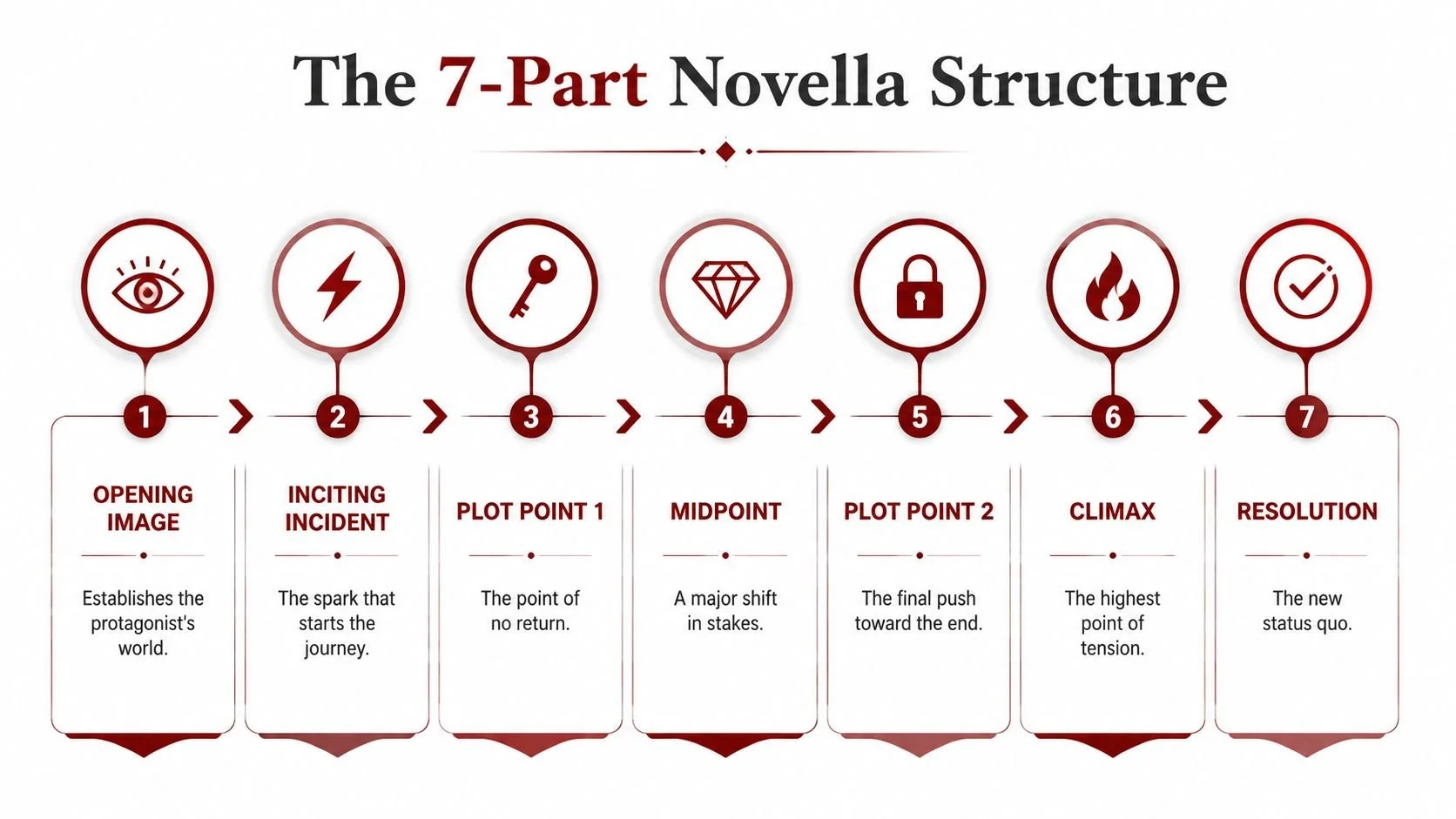
For novellas, I favour a seven-part structure because it is tight without being mechanical. It gives you enough support to draft quickly, but not so much that the story feels assembled from rigid beats.
The sequence looks like this:
Opening
Inciting Shift
Rising Tension
Midpoint Turn
Compression Phase
Climax
Resolution
If you need help condensing this into a book pitch, a clear plot synopsis process will usually expose weak spots in the outline before you draft.
The 7-part novella structure
| Stage | Word Count % | Key Focus |
|---|---|---|
| Opening | 10 to 15% | Hook the reader fast and establish the central problem |
| Inciting Shift | Early | Introduce the change that cannot be undone |
| Rising Tension | 40 to 50% | Escalate the main conflict with no filler scenes |
| Midpoint Turn | Mid-book | Force a reveal, reversal, or hard decision |
| Compression Phase | 20 to 25% | Tighten pressure and remove all detours |
| Climax | 10 to 15% | Deliver direct confrontation with the core conflict |
| Resolution | Brief | Close the arc cleanly without dragging on |
Each part has a job. The opening isn't for leisurely setup. The midpoint isn't decorative. The compression phase is where weaker drafts often fail because the writer starts adding explanations instead of increasing consequence.
A novella outline should feel slightly strict. That's a feature, not a flaw.
How to test whether a scene belongs
Use a hard filter. Ask these three questions for every scene:
Does it move the central conflict forward
Does it force a decision, reveal, or consequence
Would the story weaken if I cut it
If the answer is no more than once, the scene is in danger.
This is the discipline most first-time authors underestimate. In a novel, a scene can deepen atmosphere and still earn its place. In a novella, every scene needs two jobs at minimum. It should advance plot and sharpen character, or tighten tension and reveal motive. One job is rarely enough.
Writing with Pace, Precision, and Focus
A novella does not earn slack
The biggest pacing difference between a novel and a novella is simple. In a novella, you don't earn the right to slow down.
That changes how you draft scenes. Start later than feels comfortable. End earlier than your instinct says. Enter when something is already in motion. Leave once the emotional or narrative turn has landed.
A few drafting habits make an immediate difference:
Open inside action. Start the scene at the moment of tension, not with approach or setup.
Cut the runway. If the first paragraph only explains where the character is and what they already know, trim it.
Exit on change. End the scene when something shifts. Don't explain the shift twice.
Carry one thread. Keep the reader's attention on the main conflict, not side concerns.
Writers who are used to novels often over-prepare scenes. They front-load context, remind the reader of earlier events, and soften transitions. In a novella, that drains energy fast.
Start scenes late. End them early. Trust the reader to connect the middle.
How to build character without slowing the story
A novella still needs full characters. It just reveals them differently. You don't have pages to unload biography, childhood wounds, and worldview essays. Character comes through choice under pressure.
Use these methods instead of long explanation:
Dialogue under strain shows hierarchy, insecurity, and motive quickly.
Specific action reveals personality faster than self-description.
Selective detail can suggest background without stopping the story.
Repeated behaviour creates a pattern the reader understands.
For example, if a protagonist always avoids direct answers until the midpoint, then finally says the hard truth in the climax, you've shown growth through behaviour. That's stronger than telling the reader they became brave.
A novella also benefits from tight point of view control. One point of view is often the cleanest option. If you use more than one, do it because the story requires it, not because you're afraid of missing information. More viewpoints usually mean more setup, more transitions, and more drag.
Here's a useful drafting check:
| If you write this | Try this instead |
|---|---|
| A paragraph of backstory before the conflict | One loaded line that hints at history |
| A scene that explains motive | A decision that proves motive |
| A new side character to add texture | A sharper use of an existing character |
Precision doesn't make the story smaller. It makes it stronger.
How to Revise and Edit Your Novella Manuscript
A novella rarely improves through minor polish. It improves when the writer treats revision as part of the form itself.
That distinction matters. A novel can survive a few indulgent scenes and recover later. A short story can get by on compression and implication. A novella has far less room for either mistake. If the structure is loose, the middle sags fast. If the arc is thin, the whole book feels slight. Revision is where you make the manuscript read like a deliberate novella instead of an underbuilt novel or an overextended short story.
Fix the story architecture first
Sentence work comes later. Start by testing whether the book holds together at the level of design.
Read the draft in one or two sittings if you can. That is how readers experience a novella, and it is the only reliable way to judge pacing. Mark the places where momentum dips, where a scene repeats information, or where the emotional turn arrives before the plot has earned it.
Focus on four questions:
Is the central conflict clear early? A reader should know what pressure is shaping the story.
Does each scene either complicate the problem or force a decision? If not, cut it or combine it.
Does the protagonist change through action, not explanation? In a novella, the arc has to show on the page through choices.
Does the ending solve the story you told? Many novice drafts build toward one problem, then resolve a different one.
I often tell first-time authors to write the book's spine in five lines: setup, disruption, first major turn, crisis, resolution. If one of those beats is muddy, revision usually stalls because the manuscript is trying to do too much in too little space.
Use separate passes with separate jobs
A disciplined revision process works better than one giant "edit everything" pass. Different problems need different attention.
Pass one is structural. Cut scenes that only provide atmosphere. Collapse duplicate characters. Remove subplots that ask for a bigger canvas than the novella can support.
Pass two is scene-level. Check entry and exit points. Start later in scenes. End sooner. Make sure every exchange changes the pressure, the information, or the relationship.
Pass three is line-level. Tighten repetition, sharpen verbs, and trim explanation that weakens the prose. If a sentence is beautiful but slows the turn of the scene, it is serving the writer more than the book.
Pass four is proof and consistency. Check timeline, names, continuity, formatting, grammar, and point of view control.
For a practical breakdown of what belongs in each stage, this guide to different types of manuscript editing helps separate developmental editing from copyediting and proofreading.
Watch for the failures novellas are prone to
The common revision mistakes in novellas are specific to the form.
One is underdevelopment. The premise is strong, but the conflict has only enough material for a short story. Another is bloat. The writer adds side scenes, extra backstory, or secondary threads to make the book feel bigger, and the result is drag. A third is false intensity, where every scene pushes for drama but the escalation pattern is flat, so the climax feels loud rather than earned.
A good revision pass checks for balance. The story needs enough complexity to feel complete and enough restraint to stay sharp.
Professional editing changes what the writer can no longer see
Self-editing gets a manuscript only so far. Familiarity hides weak links. Writers know what a scene is meant to do, which makes it harder to notice when the scene does not fully do it.
A developmental editor can identify pacing breakdowns, thin causality, or an ending that lands emotionally but not structurally. A copyeditor handles clarity, consistency, and sentence control. Those are separate functions. Combining them too early usually means the manuscript gets cleaner before it gets better.
That is often the difference between a competent draft and a publishable novella. The form rewards precision, and precision is hard to judge from inside your own manuscript.
Formatting, Publishing, and Marketing Your Novella
Finishing the manuscript is only part of the job. First-time authors often underestimate how much the reading experience depends on formatting, metadata, file quality, and positioning. A well-written novella can still look amateur if the ebook breaks on devices or the print layout feels cramped.
That matters even more because, as Reedsy notes in its discussion of novella guidance gaps, most advice focuses on craft and skips commercial viability. It often doesn't tell Canadian indie authors how to position novellas in the market, how to think about pricing, or how shorter books fit with print-on-demand realities.
Format for the reader, not just the file
Formatting isn't just technical cleanup. It shapes readability.
For ebooks, clean reflowable text matters. Chapter headings, paragraph spacing, scene breaks, linked tables of contents, and device testing all affect how professional the book feels. If you want a useful primer, this overview of ebook formatting basics covers the difference between a manuscript and a retail-ready digital file.
For print, typesetting choices matter just as much:
Trim size affects how substantial the book feels in hand.
Margins and leading affect comfort on the page.
Front matter needs to be complete and correctly ordered.
Cover spine width must match the final page count and paper choice.
A novella has less room to hide production mistakes. Thin books show design imbalance quickly.
Publishing choices for Canadian self-publishers
For many indie authors in Canada, the practical route is a mix of digital and print-on-demand distribution. Amazon KDP and Kobo Writing Life are common options because they offer direct access to major retail channels and manageable setup for new publishers.
Before uploading, make sure the basics are settled:
ISBN decision. Know where your identifiers come from and how they'll be used across formats.
Metadata. Your subtitle, description, keywords, and categories do heavy lifting.
Files. Export the correct print-ready PDF and validated ebook file.
Proofing. Order a print proof and inspect it physically before approving.
How to position a novella so it does not feel minor
A novella should never be marketed like a lesser version of a novel. Readers respond better when the book is framed by experience, not apology.
Don't undersell it with language that sounds defensive. Avoid descriptions that imply it is "quick" because it is small. Focus instead on what the form offers: concentrated tension, fast immersion, and a complete reading experience without filler.
Many authors need practical support at this stage. Not because publishing tools are impossible, but because each technical decision affects discoverability, compliance, and reader trust. Clean production is part of the product.
Frequently Asked Questions About Writing a Novella
Can any genre work as a novella
Yes, but some premises fit the form better than others. Mystery, horror, romance, literary fiction, speculative fiction, and suspense can all work well if the story centres on one strong line of conflict. Stories that depend on broad world-building, many factions, or multiple equal protagonists are harder to execute at novella length.
How many main characters should a novella have
Keep the cast tight. A novella usually works best when one protagonist carries the emotional arc and only a few other characters directly pressure that arc. If you need a character chart to keep track of everyone, the cast is probably too large for the form.
Can you turn a short story into a novella
Yes, but don't stretch it by adding filler. Rebuild it around consequence.
One effective approach is to treat the short story as the opening movement rather than the whole piece. A strong example is a writer who began with a 5,000-word short story that ended just as the premise became most interesting. The solution was not to pad scenes or add extra characters. The stronger move was to ask what happens after the original ending, deepen the consequences of the core conflict, and add one new layer of tension.
A short story becomes a novella when you extend pressure on the main idea, not when you decorate it.
Should you publish a novella in print or ebook first
That depends on your goals, budget, and readership. Ebook is often the simpler first release because production is leaner and turnaround is faster. Print can still be worthwhile, especially if you want direct sales, author copies, or a fuller retail presence. Many indie authors choose to prepare both properly rather than rush one.
Do you need a professional editor for a novella
If you want a market-ready book, yes, or at minimum you need serious outside feedback. Novellas are unforgiving. Structural weakness shows fast because there is no extra length to absorb it. A good editor helps you identify what to cut, what to deepen, and whether the arc lands for a reader who does not already know the story.
If you want experienced help turning a draft into a publishable novella, Foglio Publishing offers Canada-based support across editing, formatting, ebook production, print setup, and distribution. For first-time authors, that kind of done-with-you guidance can remove a lot of guesswork while keeping the book aligned with professional publishing standards.
