
How To Write A Memoir That Connects With Readers
Most first-time memoirs go wrong because the writer starts with a timeline instead of a story. If you want to know how to write a memoir, start by choosing the part of your life that carries a clear question, conflict, or change. A strong memoir is not your whole life on paper. It is a shaped narrative from your life that helps a reader understand something meaningful.
Many popular guides tell writers to begin at the beginning. That advice creates slow openings, crowded drafts, and chapters that explain too much before anything happens. The better approach is simpler. Find the thread. Build around it. Then write scenes that serve that thread.
Your Memoir Is a Story Not a Diary
The biggest mistake I see is simple. Writers confuse memory order with story order.
A memoir is not an autobiography. It doesn't need to cover every year, every move, every job, or every relationship. It needs to follow a line of meaning. That line might be grief, immigration, addiction, faith, illness, divorce, ambition, caregiving, or a long effort to understand a parent, a marriage, or yourself.

If you write your life in order, the manuscript usually becomes a sequence of events. This happened, then this happened, then this happened. The reader may respect the life, but they won't always feel the pull of a narrative.
What works is choosing a central theme or driving question. Ask yourself:
What am I trying to understand now
What changed me
What did this period of my life cost me
What do I want the reader to carry after the last page
Practical rule: If you can't describe your memoir in one sentence, the book probably isn't focused yet.
A useful test is to finish this sentence: This is a story about... Not your whole life. Not your family tree. Not every hard thing you've survived. Just the core movement of the book.
Here is the difference in practice:
| Weak focus | Strong focus |
|---|---|
| My life from childhood to retirement | How caring for my mother changed my idea of duty |
| Everything that happened after I moved to Canada | How immigration split my sense of identity and rebuilt it |
| My marriage and divorce | How I kept confusing endurance with love |
Once that focus is clear, cutting becomes easier. Background only stays if it sharpens the story you are telling now.
Finding the Story Buried in Your Memories
Writers often think they have either too many memories or none that matter. Usually the central problem is that the material hasn't been tested yet. Raw memory is not the same as usable memoir material.
Three exercises help uncover what belongs in the book.
Start with urgency not nostalgia
Write one page answering this question: Why this story now?
Not ten years ago. Not ten years from now. Now.
That prompt forces you to identify your present-day perspective. Memoir needs hindsight. If you're only recording what happened, the book stays flat. If you understand why the story matters to you now, the book gains shape and authority.
Try answering these in a freewrite:
What can I see now that I couldn't see then
What belief did I lose
What part of this story am I finally ready to tell
Why would silence be easier
If your answer stays vague, your subject may still be too broad. Narrow the time frame. Narrow the relationship. Narrow the emotional problem.
The sharper the question, the stronger the memoir.
Use discomfort as a signal
Take a key memory and rewrite it with what I call an uncomfortable truth pass. Add the thought you left out. Add the resentment, shame, jealousy, relief, fear, or pettiness you didn't want on the page.
Most weak memoir drafts are overprotected. The facts may be true, but the emotional truth is guarded.
A few examples:
Instead of “I was devastated when my brother left.”
Try “I was devastated, but I was also angry that he got to leave and I had to stay and manage what he escaped.”
Instead of “I wanted to support my father.”
Try “I wanted to support him, and I wanted him to finally say I had done enough.”
This doesn't mean turning every chapter into confession. It means refusing to hide the inner conflict that gives the story force.
Expand one moment until it becomes a scene
Pick a turning point and write it at full length. Don't summarise it. Slow it down.
A useful exercise is the single moment expansion. Take one event and stretch it into a full scene using:
Physical setting
What room were you in. What could you smell, hear, or touch.Action
Who moved first. What object mattered. What happened second by second.Inner response
What did you think but not say.Aftermath
What changed in the next hour, not just the next year.
Many writers discover that the moments they thought were “small” are the engine of the book.
Here are signs you've found strong material:
You resist writing it
The memory contains a choice, reversal, or realisation
You can picture the setting clearly
The scene changes how the reader understands what comes next
When enough of these moments gather around the same emotional thread, you no longer have a pile of memories. You have a memoir.
How to Structure a Memoir Narrative
Once the story's core is clear, the next task is arrangement. Many manuscripts improve rapidly during this stage. The material is often good, but the order is wrong.
According to the Writers' Union of Canada, 68% of memoir manuscripts submitted for evaluation fail initial structural reviews due to a lack of focus, and authors who use a three-act structure with a 25%-50%-25% distribution have 40% higher completion rates.

Build around change
A memoir needs movement. That movement does not have to be dramatic in an external sense, but the reader has to feel that something is shifting.
The cleanest way to test your structure is to map three points:
Beginning
Who are you before the central conflict fully breaks open.Middle
What pressure forces change, denial, loss, action, or confrontation.End
What understanding, cost, or new stance closes the arc.
If your draft has many events but no clear escalation, you probably have chronology instead of narrative.
A better opening than childhood background
One of the most effective memoir restructures I guided involved a manuscript that opened with several chapters of childhood history before the core story began. The emotional centre of the book was a major event in the writer's thirties. We moved that moment to page one.
The result was immediate. The book gained tension, purpose, and curiosity.
Instead of making the reader wait for the story, we used selective flashbacks. Childhood material appeared only when it deepened the emotional meaning of the present action. Two chapters were cut. Others were merged. Nothing important was lost. The story became readable.
Open where the pressure starts, not where the calendar starts.
A simple structure you can use
If you're not sure how to organise your memoir, use this working model:
| Part | What it does | Common mistake |
|---|---|---|
| Act 1 | Establishes the problem, desire, and stakes | Too much backstory |
| Act 2 | Complicates the conflict and tests the narrator | Repetitive scenes with no escalation |
| Act 3 | Delivers the emotional consequence and resolution | Ending too abruptly after the climax |
A few practical choices help:
Use a cold open if the key event is strong enough to hook the reader.
Group chapters by emotional movement, not only by year.
Cut explanatory sections when a scene can do the work better.
Repeat motifs carefully so the reader feels continuity without feeling hammered.
Structure is where memoir stops being private writing and starts becoming a book.
Writing Scenes and Developing Your Voice
Strong memoirs don't just explain what happened. They place the reader inside a moment.
That sounds obvious, but many first drafts lean on summary. BookNet Canada's 2025 Indie Author Survey found that telling over showing snares 70% of first-time memoirists, and work built from vivid scene bubbles can uncover organic themes in 82% of cases. The lesson is practical. If the page keeps reporting events from a distance, the story loses force.
Write scenes not reports
A report sounds like this:
I was nervous about seeing my mother in hospital and didn't know what to say.
A scene sounds like this:
The room smelled like bleach and warm plastic. My mother's water cup sat untouched beside the bed. I stood in the doorway pretending to read the chart because I couldn't make my feet move.
The second version gives the reader something to experience. Sensory detail, gesture, silence, and internal reaction do more than explanation.
To improve scene work, build around these elements:
Concrete setting
Name the room, the weather, the object in your hand, the sound in the hall.Behaviour under pressure
Show what you did when you were afraid, ashamed, hopeful, or furious.Specific dialogue
Use dialogue when it reveals tension or character. Don't force long reconstructed conversations that sound polished.Interiority
Let the reader hear the thought you didn't say aloud.
If you're working in first person, this guide to first-person narrative is useful for understanding how closeness, distance, and reflection affect voice on the page.
Clarity makes voice stronger
First-time memoir writers often try to sound literary by making the prose denser. It usually has the opposite effect. Readers trust a voice that is precise, direct, and honest.
Compare these approaches:
| Overwritten | Clear |
|---|---|
| My grief existed as a permanent weather system hovering over the architecture of my consciousness | Grief followed me into ordinary tasks |
| I endeavoured to articulate the ineffable fracture within our domestic sphere | I couldn't say what was broken in our house |
The clearer version lands harder because the emotion isn't buried under performance.
A useful revision pass is to mark every sentence that sounds more clever than true. Then rewrite it in plain language without losing meaning.
Your voice isn't the decoration on the story. It's the way you see, choose, and tell the truth.
Editing, Polishing, and Legal Considerations
Most memoir drafts need more than correction. They need decisions.
Good editing happens in layers. If you try to fix everything at once, you miss bigger issues and waste time polishing pages that may later be cut. This is also the stage where memoir becomes legally and ethically serious, because real people, real events, and real records are involved.
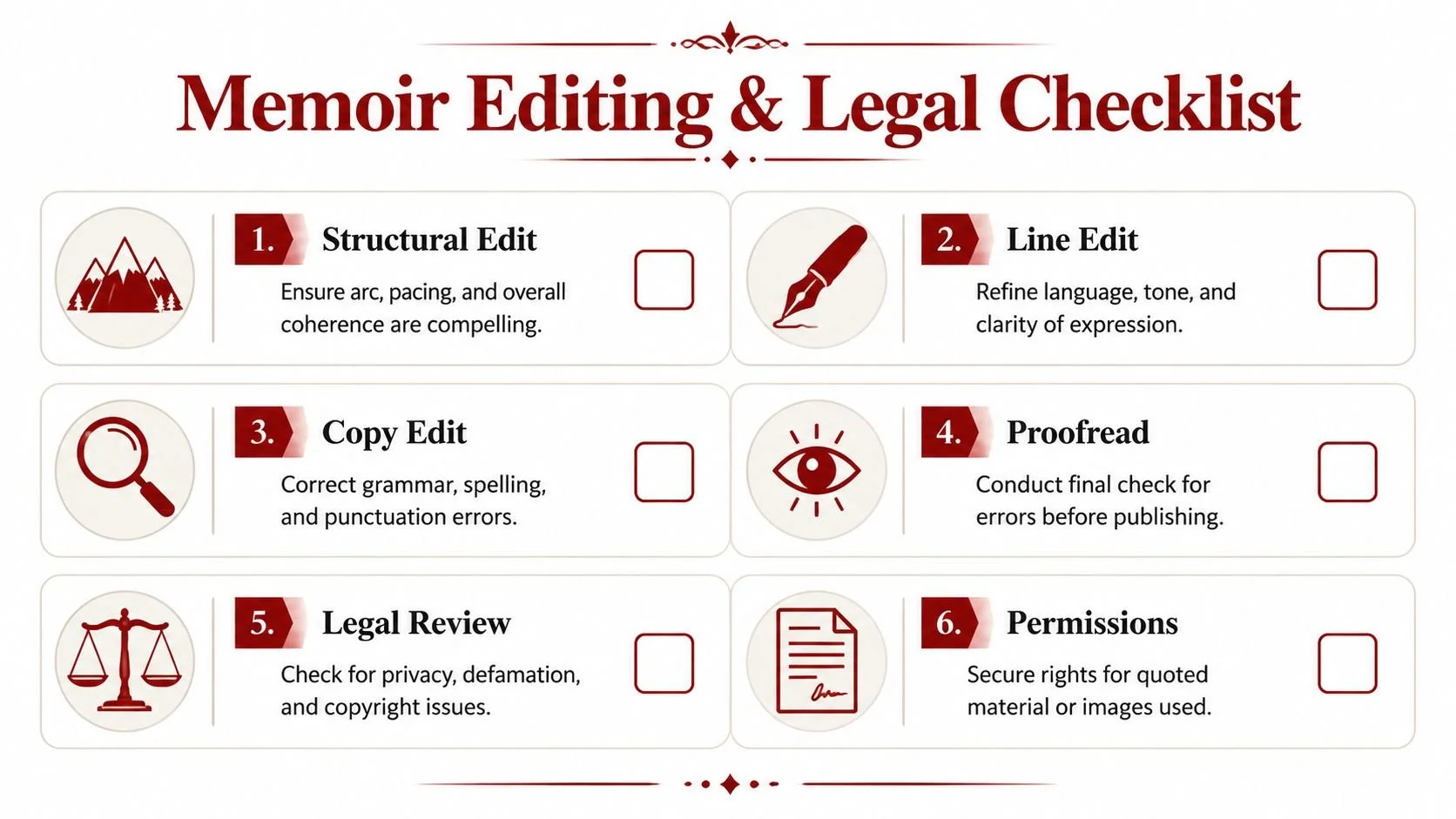
Edit in separate passes
Use different passes for different problems.
Structural edit
Check the arc, chapter order, pace, and omissions. Ask where the story drags, where it withholds too much, and where it repeats itself.Line edit
Improve rhythm, sentence clarity, transitions, and tone. In this stage, muddy paragraphs become readable.Copyedit
Correct grammar, spelling, punctuation, continuity, and usage.Proofread
Catch final errors after formatting, not before.
If you want a clearer sense of what each stage covers, this overview of manuscript editing types breaks them down plainly.
Many writers can revise their own pages to a point. Then they hit the limit of familiarity. They know what they meant, so they stop seeing what the page says. An outside editor is useful here because they can spot missing context, weak transitions, and scenes that carry emotion for the writer but not yet for the reader. One option in Canada is Foglio Publishing, we offer manuscript evaluation, structural editing, copyediting, proofreading, and production support for self-publishing authors.
Treat legal review as part of the manuscript
Legal review is not a last-minute formality. It affects what evidence you keep, how you describe real people, and whether a scene can stay as written.
A 2024 Writers' Union of Canada survey found that 68% of memoirists worried about lawsuits from portraying real people, yet only 12% felt prepared. In Canada, truth is a defence against defamation, but proving it requires evidence, which is why fact-checking matters so much.
Use this checklist before publication:
Check your evidence
Keep notes, dates, emails, photos, public records, or journals that support disputed facts.Review identifying details
Ask whether a person can be recognised even if you change the name.Separate memory from certainty
If you don't know the exact words spoken, don't present them with false precision.Watch privacy issues
Medical, family, and intimate material can create both legal and relational problems.Get permission when needed
Quoted letters, song lyrics, photographs, and other protected material may require rights clearance.
You don't need to write with fear. You do need to write with care.
Taking Your Memoir to Print with Self-Publishing
Publishing your memoir is not just uploading a file. It is the final stage of shaping the reader's experience.
The Writers' Union of Canada reports that self-published memoirs in Canada grew 55% from 2020-2025, with 72% of these titles coming from first-time authors, many using full-service providers to handle technical tasks such as ISBN registration and print formatting. That growth matters because it shows two things. More writers are taking this route, and many of them need help turning a manuscript into a professional book.
What publishing-ready actually means
A publishable memoir needs more than a finished draft. It needs:
A professional cover that matches the tone and category of the book
Interior formatting that gives the pages balance, readability, and clean chapter starts
ISBN setup appropriate for the edition
Print-ready files that meet retailer and printer requirements
Distribution choices for print-on-demand, direct printing, eBook, or a mix
A memoir can be thoroughly personal and still look polished. It should.
Why many authors get help at this stage
The final production steps are technical, and mistakes are visible. Bad margins, weak cover typography, inconsistent front matter, and broken eBook files make a serious manuscript look amateur.
If you're preparing your book yourself, these five self-publishing steps offer a practical overview of the process. If you want guidance, a full-service partner can handle design, formatting, files, print coordination, and distribution while you stay focused on the content and launch.
A good memoir deserves a professional container.
Frequently Asked Questions About Writing a Memoir
How long should a memoir be
There isn't one perfect length, but many first-time memoirs improve when they become shorter and more selective. If your draft keeps expanding, that's often a sign that the book still includes material that belongs in private notes, not the final manuscript.
A better test than raw length is this question: does every chapter deepen the central story?
Can I write a memoir about real people without permission
Sometimes yes, but you need to be careful. The issue isn't only permission. It's accuracy, privacy, fairness, and whether you can support what you've written if challenged.
If a person is central to the story, review what is factual, what is remembered, and what may expose you to legal risk. Change identifying details when appropriate, but don't assume a new name solves everything.
What if my life doesn't feel interesting enough
Most compelling memoirs aren't built on unusual events alone. They work because the writer understands the emotional stakes.
Readers don't need you to have lived an extraordinary life. They need you to tell a specific story with honesty, shape, and insight. A book about caregiving, debt, migration, estrangement, illness, faith, or ambition can connect strongly if the writing is concrete and the narrative is focused.
Should I write my memoir in order
Usually, no. Write scenes and memories in the order they come to you if that helps you draft, but don't assume the final book should follow the calendar.
Chronology is a record. Narrative is an experience. Memoir needs the second one.
How do I know where my memoir should start
Start where the reader feels the pressure of the story. That may be a diagnosis, a departure, a confrontation, a move, a death, a betrayal, or a decision. Background can come later in carefully chosen pieces.
Do I need an editor for a memoir
Many writers can draft alone. Fewer can accurately judge the structure, pace, clarity, and legal risk of their own manuscript. Memoir is personal, which makes distance harder. An editor helps you see the book as a reader will.
If you're ready to move from notes and rough chapters to a finished book, Foglio Publishing offers practical support for memoir writers across editing, design, formatting, ISBNs, and self-publishing production.
