
What Font Is Used for Books? A Pro Guide for Authors
If you're staring at a manuscript in Word or InDesign and wondering what font is used for books, the short answer is this: most professionally typeset print books use serif fonts for the body text, and in Canadian self-publishing the most common choice is Garamond. Caslon is also a popular option for nonfiction and historical projects. The font itself matters, but the main difference between an amateur interior and a polished one comes from how that font is set on the page.
That’s where many first-time authors get tripped up. They pick a familiar font, often Times New Roman because it feels “standard,” then assume the job is done. It isn’t. A readable book depends on a chain of decisions: typeface, size, leading, margins, licensing, and file prep. Get those working together and the pages disappear behind the reading experience, which is exactly what good book typography should do.
Table of Contents
What Fonts are Used in Books? A Full Author’s Overview
Books are usually set in serif typefaces such as Garamond and Caslon because those faces are built for extended reading. If you're asking about the most common font for books, Garamond is the most common font you’ll see in many trade interiors, especially in self-publishing.
That doesn’t mean one font suits every manuscript. A historical novel, a business guide, a memoir, and a workbook don’t ask the page to do the same job. Typography needs to match the tone of the writing while staying invisible enough that readers don’t notice it.
How to Choose Your Book’s Font
My advice? Choose your book’s font for reading first, personality second.
Authors often reverse that order and end up with pages that look distinctive in a sample spread but become tiring over a full chapter.
Practical rule: If a font looks interesting because it calls attention to itself, it’s usually the wrong body font for a standard book interior.
Professional interiors also depend on restraint. Most books don’t need a “creative” body font. They need a dependable one with clean italics, solid bolds, proper punctuation, and spacing that holds together across hundreds of pages.
The best font for a book is the one that supports long-form reading, fits the genre, and is set with proper size, leading, and margins. The typeface name matters. The page system around it matters just as much.
Understanding the Two Families of Book Fonts
Why Serif Fonts are Common for Book Interiors
Most book fonts fall into two broad families: serif and sans-serif.
Serif fonts have small finishing strokes on the ends of letters. Sans-serif fonts don’t. That sounds technical, but on the page the difference is easy to feel. Serif fonts tend to look more settled and continuous in long paragraphs. Sans-serifs tend to look cleaner and more direct, but also more exposed when used for dense reading.
For book interiors, serif fonts usually win because they help paragraphs hold together visually. In Canadian self-publishing, Garamond stands out as the predominant serif font for book body text, and its x-height and open counterforms are linked to 15 to 20% better legibility in extended reading sessions compared to sans-serifs in recent readability data.
Think of serif body text as good joinery in furniture. You don’t admire every joint while using it, but you feel the stability.
Here’s the practical takeaway for first-time authors:
For novels and memoirs: a serif font is usually the safest and strongest body-text choice.
For dense nonfiction: serif still tends to read better over long stretches.
For print books in general: sans-serif body text often looks more like a document than a finished book.
When to Use Sans-serif Fonts Instead
Sans-serif fonts work well for:
Chapter openers: clean, modern contrast against a serif body font
Headers and subheads: especially in manuals or business books
Tables and callouts: where clarity and separation matter
Certain children’s or highly designed books: where the layout has different priorities
Sans-serif works best when it helps organize the page, not when it carries the whole reading load of a standard print book.
This is why many professional interiors combine families rather than forcing one font to do everything. Serif for body text. Sans-serif for navigation. The result feels intentional without being fussy.
The Most Common Fonts Used in Professional Book Publishing
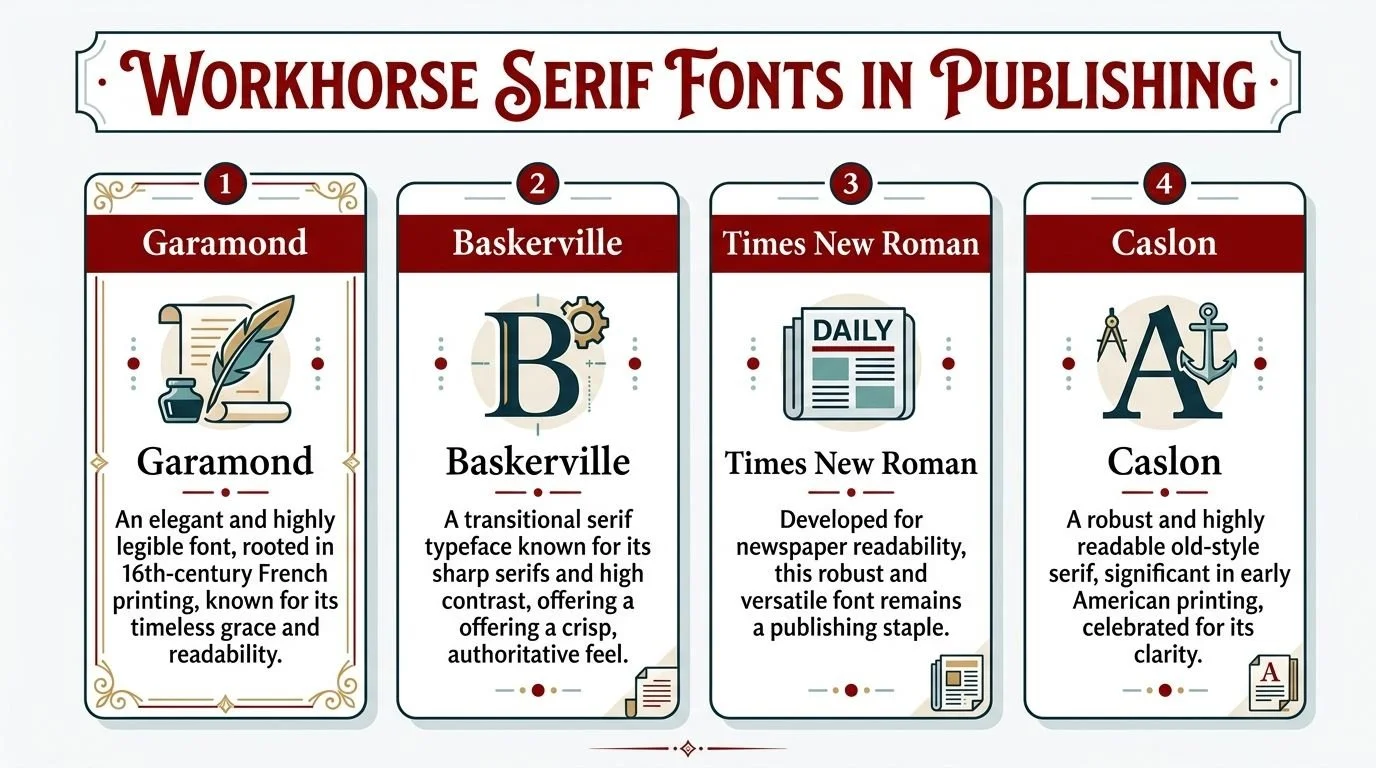
Garamond is the Most Common Font for Books
If an author asks me for the safest answer to what is the best font to write a book in, I usually start with Garamond for fiction and general trade books.
In practice, Garamond reads gracefully without looking old-fashioned, and it uses space efficiently enough to keep long novels from bloating unnecessarily. That’s one reason designers keep coming back to it.
In Canadian self-publishing, Garamond is the predominant serif for body text, and the verified data notes that 11 pt Garamond often lands in a character count per line of 65 to 75 for 6x9-inch trade paperbacks, which aligns well with common print-on-demand expectations. The same verified source also notes that 70% of self-published novels use Garamond variants and points to Garamond Pro as a strong option for bilingual French-English support because it includes 1,400+ glyphs.
I’ve also seen Garamond solve a very common problem. A page can look acceptable in a short excerpt but start to feel grey and cramped once you read a full chapter. Slightly opening the leading and adjusting kerning can make the same font feel calmer without changing the book’s voice.
Caslon for Nonfiction and Historical Work
Caslon is one of the most reliable answers for nonfiction, historical writing, and more formal interiors.
It carries authority well. Not a cold, corporate authority. More a composed, bookish one. That makes it useful for memoir, essays, academic-leaning trade nonfiction, and subjects where you want clarity without sterility.
The verified data states that Caslon is a top expert-recommended font for nonfiction and historical books in Canada and traces its origins to 1722 by William Caslon I. It also notes a 52% x-height, use by 40% of Canadian academic presses for theses and manuals, and practical specs such as 11.5 pt with 13 pt leading for 5.5x8.5 memoirs, yielding 300 to 350 words per page.
Pairing Caslon body text with Helvetica headers at 12 to 14 pt can work well in technical nonfiction. That combination gives the page structure without making it feel designed for the sake of design.
Other Common Book Font Choices
Not every strong book interior uses Garamond or Caslon. Other popular font choices include Minion Pro, Baskerville, and in some contexts Times New Roman.
Here’s how I think about them:
| Font | Common Feel | Where It Works Well | Watch For |
|---|---|---|---|
| Minion Pro | Clean, modern, even | Business books, memoir, contemporary nonfiction | Needs proper spacing so it doesn’t feel plain |
| Baskerville | Crisp, literary, slightly formal | Historical fiction, essays, elegant trade titles | Can feel high-contrast if the printing is poor |
| Times New Roman | Familiar, compact, document-like | Manuscript submission, not usually final interior | Often feels tight and generic in finished books |
Times New Roman isn’t “bad” but it’s associated more with manuscripts and office documents than with a refined print interior. Once you compare a few full chapter samples, that difference becomes obvious.

How to Choose the Right Font for Your Book's Genre
Font choice is partly technical and partly editorial. The same manuscript set in different type families can feel more literary, more commercial, more academic, or more contemporary without a single word changing.
Fiction and Narrative Nonfiction
For literary fiction, historical fiction, and many general novels, Garamond is a natural starting point. It has a classic cadence on the page. That matters when you want the typography to be immersive.
For memoir and narrative nonfiction, the choice depends on voice. A reflective memoir can sit beautifully in Garamond or Caslon. A more current, uncluttered narrative may feel stronger in Minion Pro, which often looks a little cleaner and less ornamental.
Here are the fonts I’d recommend based on genre:
Historical or literary fiction: start with Garamond or Baskerville
Commercial fiction: Garamond often works because it stays readable without feeling stiff
Memoir: Garamond, Caslon, or Minion Pro depending on tone
Essay collections: Caslon or Baskerville if the voice is formal, Minion Pro if it’s contemporary
One of the easiest mistakes is choosing by alphabet specimen alone. A font can look beautiful in samples but disappoint in ten consecutive pages of body copy.
Set at least a full chapter before deciding. Type performs differently in a paragraph than it does in a font menu.
Business, Memoir, Academic, and Bilingual Books
For business books, manuals, and practical nonfiction, I usually look for clarity first. Caslon and Minion Pro are useful here because they feel organized and mature without turning the interior into a textbook (unless the content asks for that).
For academic or reference-heavy work, structure matters as much as body text. You need a body font with good figures, italics, and punctuation, plus a heading system that won’t collapse into clutter.
Canadian authors also need to think about bilingual typesetting. BookNet Canada’s 2025 Self-Publishing Report shows 28% growth in bilingual nonfiction and memoir titles, and standard recommendations often fail diacritic rendering for French text.
That matters if your book includes French headings, quotations, or full bilingual layouts. In those cases:
Check diacritics carefully: don’t assume every common font handles French gracefully
Review italics and bolds in both languages: some families feel uneven across styles
Test chapter pages, not just body paragraphs: bilingual problems often show up in headings, captions, and running elements first
For children’s books and heavily illustrated books, the rules aren’t nearly a strict. Readability still comes first, but tone and display typography take on a larger role than they do in standard trade interiors.
Professional Typesetting for Readability and Flow
A good font can still produce a bad page. That’s the part many authors don’t realize until they compare a DIY layout with a professionally typeset sample.
Font size and Leading Matter More Than Most Authors Expect
When authors ask what is the best font and size for a book, they’re usually looking for one universal setting. There isn’t one. Size and leading have to respond to the typeface, trim size, page count, and reading context.
Still, there are patterns that work.
Garamond at a tight size with cramped leading can feel elegant in a short sample and oppressive across a full chapter. I’ve corrected interiors where the text technically “fit” but readers would have had to work too hard to stay comfortable. Slightly increasing the font size and loosening the leading solved the problem without changing the overall design language.
Here’s what I look for on sample pages:
Can the eye return to the next line easily? If not, the leading may be too tight.
Does the page look grey and dense? The font may be too small, too dark, or too compact for the trim.
Do paragraphs feel like separate units? If not, spacing and indentation may need adjustment.
A page should feel steady. Not crowded, not airy, and never “designed” so hard that reading becomes the second priority.
Margins and baseline grids create a calm page
Professional interiors rely on geometry that readers never consciously notice. One key tool is the baseline grid, which keeps lines aligned consistently across pages and through different text elements.
For a standard trade paperback, the verified data states that professional typesetters often match the baseline grid to the body text leading, such as a 14 pt grid for 11/14 text, and use asymmetrical margins with an inside margin of around 0.75" to 0.9" to account for binding and improve readability. That guidance appears in the verified dataset connected to Foglio’s blog.
That asymmetry matters. New designers often default to even margins because symmetry feels tidy. In bound books, equal margins usually produce a less comfortable text block because the spine eats into the inside space.
A better page usually has:
| Element | What Usually Works | What Often Goes Wrong |
|---|---|---|
| Inside margin | Slightly larger for binding | Too narrow, text feels trapped in the gutter |
| Outside margin | Slightly smaller than inside | Too wide, text block feels adrift |
| Top margin | A bit tighter | So tall that the page feels top-heavy |
| Bottom margin | More room for folios and balance | Too shallow, page looks cramped |
What Works in Word and What Works in InDesign
If you’re still drafting, Word is fine. If you’re building a final interior, Word has limits.
Word can handle a clean manuscript and even a simple layout, but it becomes fragile once you start controlling line endings, folios, baseline consistency, section openers, and image anchoring. InDesign is built for those decisions.
That’s why serious interiors usually move into a proper layout workflow before export. One practical option is to work from a spec sheet that previews body font, headers, footers, and spacing before full production begins. Foglio Publishing offers that kind of layout preview as part of our production process, which is useful when an author needs to compare type choices in context rather than guess from a font list.
The goal isn’t to make the page ornate. It’s to make it disappear.
Font Licensing and File Preparation for Print and eBook
A font choice isn’t finished when the page looks good on your screen. It’s finished when you have the legal right to use it and the file is prepared so the printer or eBook system reproduces it correctly.
Why Font Licensing is Not a Minor Detail
Many first-time authors assume that if a font is installed on their computer, they can use it for a commercial book. That assumption isn’t true.
A 2025 BookNet Canada survey found that 22% of indie print submissions failed formatting checks due to unlicensed typefaces, and that risk affects the 12,347 self-published titles reported by Statistics Canada in 2025. You can learn more about this with Amazon KDP’s font and file guidance.
If you’re publishing through KDP Canada or IngramSpark, you need to confirm the license allows the actual use you’re making of the font. That can include commercial print use, embedding in PDFs, and sometimes digital distribution.
Watch for these problems:
Desktop use only: the license may allow local design use but restrict embedding or wider reproduction
Incomplete families: you used Regular, then added an italic later without checking the rights for the full set
Free downloads of uncertain origin: the file may work, but the license may not be valid
How to prepare font files properly
Once the license is settled, file prep becomes the next risk point.
For print:
Embed fonts in the final PDF: don’t assume the printer has your typeface installed
Check every style used: Regular, italic, bold, and bold italic all need to behave properly
Review the exported PDF carefully: especially chapter titles, folios, special characters, and front matter
For eBooks, the strategy is different. Reflowable ePub files often hand more control to the reading device, so the focus shifts from rigid page design to clean, stable structure.
If you want a practical checklist for the handoff stage, this guide to print-ready book files is a useful reference point. It helps authors separate design decisions from production requirements, which are not the same thing.
This is one area where shortcuts tend to cost time later. A font that’s attractive, licensed correctly, and embedded properly is far less likely to trigger upload headaches or proofing surprises.
Frequently Asked Questions About Book Fonts
What is the most common font for books
For many print books, especially trade fiction and general nonfiction, Garamond is one of the most common professional choices. It’s widely used because it feels classic, reads well over long passages, and uses space efficiently.
What is the best font and size for a book
There’s no single best setting for every book. A strong starting point is a readable serif font such as Garamond, Caslon, or Minion Pro, then adjust the size and leading based on trim size, page density, and the specific typeface. The right answer comes from testing actual chapter pages, not choosing a number in isolation.
What is the best font to write a book in
If you mean drafting the manuscript, use whatever keeps you writing comfortably and matches any submission requirements you may need later. If you mean the final printed interior, use a professional book face rather than a general office default.
Best fonts for books in Word
For drafting in Word, keep it simple. Common practical options include Times New Roman for manuscript submission and Garamond if you want a closer preview of a more book-like texture while writing. Just don’t mistake a Word draft for a finished interior design.
Is Times New Roman good for books
It’s acceptable for manuscript submission and internal drafts. For final book interiors, it often feels too familiar, too tight, and too document-like compared with stronger publishing choices such as Garamond, Caslon, or Minion Pro.
Should I use a sans-serif font for my book interior
Usually not for a standard print book with long-form reading. Sans-serif fonts work better for headings, callouts, and navigation elements. There are exceptions, but they should be deliberate rather than default.
Can I use free fonts in my book
Sometimes, yes. But only if the license clearly allows commercial publishing and embedding. Don’t rely on the fact that a font was easy to download. Check the license before you build the interior around it.
