
Short Run Printing for Canadian Self-Published Authors: The Complete 2026 Guide
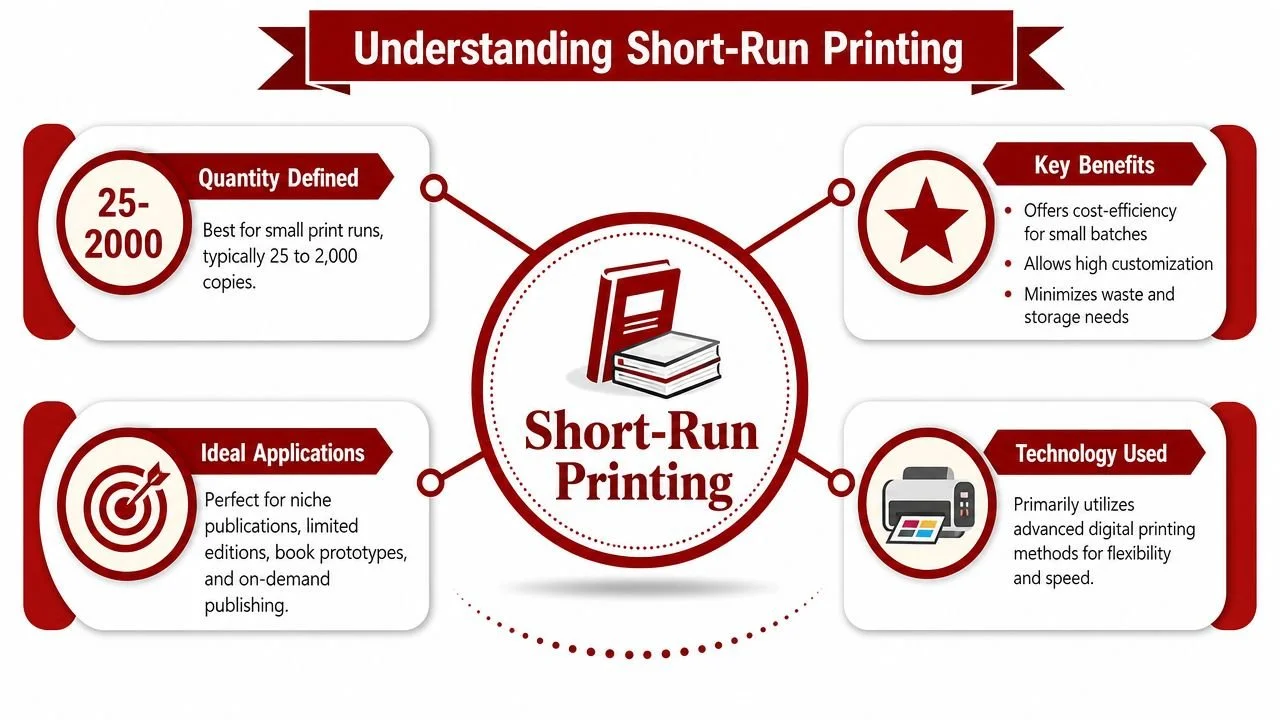
Short-run printing is the middle ground between print-on-demand and large offset runs. For Canadian authors, it usually means printing dozens to a few thousand copies, with common short-run ranges of about 25 to 5,000 pieces and a practical book-printing window of about 25 to 2,500 copies.
If you've finished your manuscript and you're now figuring out how to get physical books in your hands without spending thousands on a print run you can't sell through, this guide is for you. We'll cover what short run printing actually is, when it makes sense, what it costs, how the workflow runs from first file to finished box, and how working with a Canadian publishing partner makes every step easier.
What Is Short Run Printing — and Why Canadian Indie Authors Are Choosing It in 2026
Short run printing is the production of a small quantity of books — typically between 25 and 500 copies — using digital printing technology rather than traditional offset presses. Because digital printing doesn't require physical plates, there's no expensive setup cost, and minimum order quantities are low enough for individual authors to use without enormous upfront investment.
It's worth understanding how this fits alongside the other printing methods available to you. Print on demand (POD) technology prints one copy at a time per customer order, which means you never hold inventory. Short run digital printing, by contrast, produces a defined batch in a single production run. That distinction matters enormously: you get physical copies you can sell at events, hand to bookstore buyers, or ship to reviewers — without waiting for individual orders to trickle in.
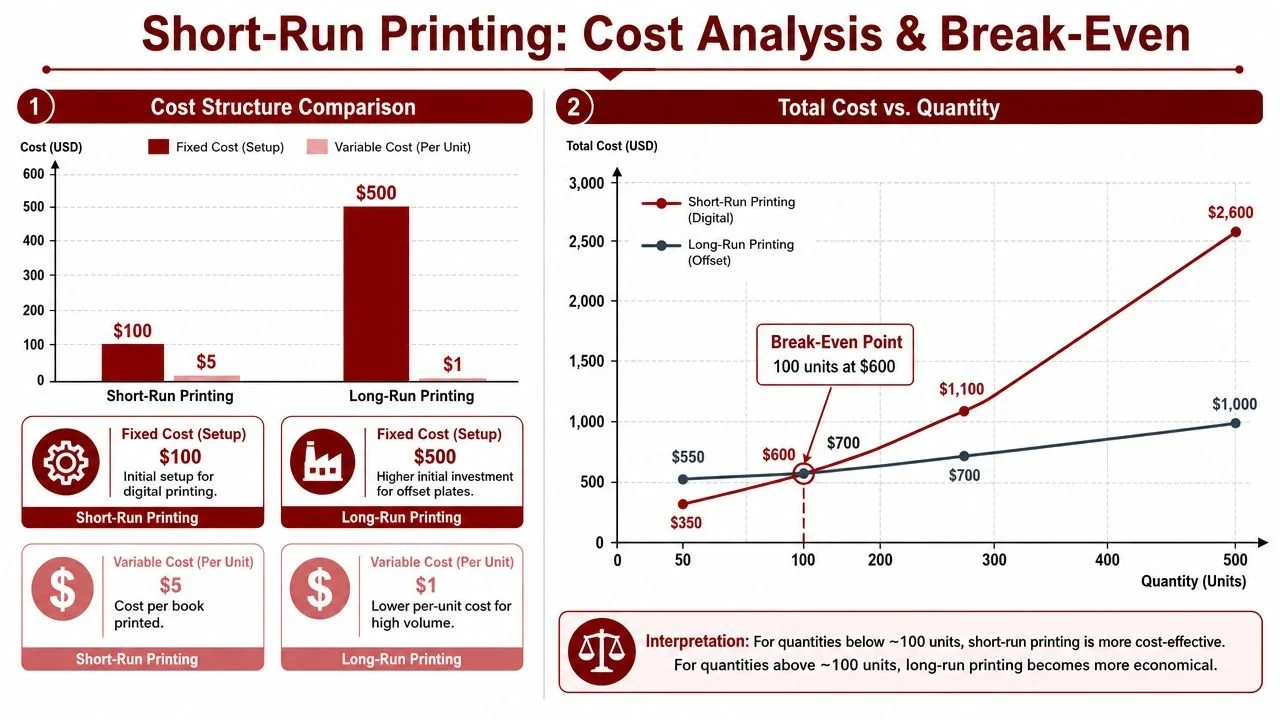
The sweet spot for most Canadian indie authors is 50–250 copies. At that range, you get a meaningful per-unit cost reduction compared to POD single-copy pricing, but you're not committing to the kind of inventory that ends up stacked in your garage for two years. Short run printing sits between POD (zero inventory, higher per-unit cost) and offset printing (lower per-unit cost, but 500–1,000+ copy minimums with significant upfront spend). It's the practical middle ground, and it's why more Canadian authors are choosing it for launch events, local bookstore pitches, and advance reader copy (ARC) campaigns.
For a full picture of how these methods compare on cost and logistics, see our breakdown of print on demand vs offset printing in Canada.
Canadian authors face a set of considerations that US-centric printing guides simply don't address. Cross-border shipping costs from US-based printers, HST and GST implications on imported goods, and Canadian ISBN assignment through Library and Archives Canada all affect the total cost and timeline of a short print run. The Ultimate Guide to Self-Publishing in Canada covers these factors in depth if you want broader context on the Canadian publishing landscape.
The Real Pain Points Canadian Self-Published Authors Face With Printing
The core pain points for Canadian self-published authors considering short run printing are: high upfront offset costs, unsold inventory risk, POD quality and margin limitations, cross-border shipping delays, and file preparation complexity.
Let's go through each one honestly.
Upfront cost anxiety is the number-one blocker for most first-time authors. Offset printing typically requires 500–1,000 copy minimums at $3–$6 CAD per unit for a standard 250-page trade paperback. That's $1,500–$6,000 committed before a single copy is sold. For an author who doesn't yet know how their book will be received, that's a significant financial risk. Our guide on cutting book production costs goes into specific strategies for managing these expenses across different edition types.
Storage is a hidden cost most first-time authors don't price in at all. Renting a storage unit, managing humidity and damage risks, and the psychological weight of boxes of unsold books sitting in a spare room for two years — these are real consequences of over-ordering on offset.
POD platforms solve the inventory problem but introduce new trade-offs. Per-copy costs for a 300-page colour interior book can reach $8–$14 CAD, which makes local retail margins essentially impossible. Consignment with a Canadian independent bookstore typically gives you 45–60% of the retail price — after a $12 print cost on a $20 book, you're losing money. Physical copy quality through major POD platforms, while adequate for online retail, often doesn't match what a Canadian printer can produce on higher-grade paper stocks. For a direct comparison, read our analysis of print on demand vs offset printing.
Cross-border shipping delays are a practical problem that Canadian authors ordering through US-based services know well. Expect 5–14 business days for author copies, plus brokerage fees you didn't anticipate, and the inability to do a quality check before a launch event you've already promoted.
File preparation is a consistent technical stumbling block. Most short run printers require PDF/X-1a files with specific bleed, margin, and colour profile settings. These are different from what most word processors export by default, and even some design tools don't produce them correctly without manual configuration. The result is rejected files and delayed print timelines — sometimes by a week or more.
Authors who skip professional typesetting and cover design to save money often end up with books that Canadian independent bookstores won't stock. These stores have clear quality standards and look for BISAC codes, proper spine text, and clean ISBN barcode placement. A book that reads as self-produced on the shelf doesn't get shelf space.
The decision between POD, short run, and offset is genuinely confusing, and most search results reflect US-centric advice. Understanding where your book fits in the self-publishing vs traditional publishing landscape helps frame why these printing decisions carry real business consequences — not just production ones.
How Short Run Printing Solves These Problems — and When It's the Right Call
Short run printing is the right choice for Canadian indie authors when they need 50–250 physical copies for a launch event, bookstore pitching, or ARC distribution — and want to avoid the high minimums of offset printing and the per-unit cost and shipping delays of US-based POD platforms. A hybrid model — short run for launch, POD for ongoing retail — is the most cost-effective strategy for most Canadian indie authors in 2026.
Here's how the math works. Short run digital printing typically starts at 25–50 copies with no plate or setup fees. A first-time author can order 100 copies of a 280-page trade paperback for roughly $600–$900 CAD all-in from a Canadian printer — a per-unit cost of $6–$9. That's competitive with POD at volume, without the cross-border complications. At 100 copies, you also get faster local turnaround: 5–10 business days from a Canadian printer versus 2–4 weeks for US POD author copies, plus the ability to inspect and approve a proof before committing the full run.
Short run printing makes the most sense in four specific author scenarios:
A book launch event where 75–150 copies are needed for direct sales and signing
Pitching to local independent bookstores that require physical copies for consignment review
Producing 20–50 advance reader copies (ARCs) for reviewers, bloggers, and podcast hosts before the official release date — see our Advance Reader Copy Program for how this works in practice
A limited or special edition with custom paper or cover finish that major POD platforms don't offer
For authors who expect ongoing sales through online retail (Amazon.ca, Indigo.ca, their own website), a hybrid approach works best: use short run printing for the launch phase and events, then set up a parallel POD listing for continuous fulfilment without inventory management. This is also where custom book printing comes in — you're not locked into standard configurations when you're working with a Canadian printer.
Short run printing does NOT make sense when an author has no events planned and expects all sales to be online (POD is cheaper per unit at one-copy volume), when the book is a children's picture book with full-bleed colour illustrations (offset is more cost-effective above 300 copies for colour-heavy books), or when the author hasn't yet validated any audience interest.
Canadian-specific advantage: ordering from a domestic short run printer means no customs brokerage fees, no cross-border GST complications on imports, and the ability to physically receive a proof within days. For the technical side of these decisions, our guide on choosing the right trim size and paper walks through exactly how paper weight, trim dimensions, and binding type affect your per-unit cost and reader experience.
Paper and trim size choices directly affect short run pricing. A 6x9 trade paperback on 60lb natural offset paper is the most cost-efficient configuration. Moving to 5.5x8.5 or adding a matte laminate cover adds minimally to cost but noticeably to perceived quality — and perceived quality matters when you're handing a copy to a bookstore buyer.
For a detailed side-by-side look at how short run printing compares to POD services on cost and distribution, see our print on demand vs offset printing comparison.
The Short Run Printing Workflow: From Finished Manuscript to Boxes at Your Door
A successful short run printing workflow for Canadian authors has seven steps: lock trim size and page count, assign a Canadian ISBN, typeset to print-ready PDF/X-1a specs, design a 300 DPI CMYK cover with correct spine width, order a physical proof, approve and schedule the run with a 15-day buffer before launch, then set up parallel POD distribution.
Here's each step in detail.
Step 1 — Lock your trim size and page count before any design work begins. These two variables determine your spine width (critical for cover design), your per-unit print cost, and whether your book fits standard bookstore shelving. The most common short run trim sizes for Canadian trade fiction and non-fiction are 5.5x8.5 and 6x9. Don't change these after typesetting begins — it reflows your entire interior.
Step 2 — Get a Canadian ISBN from Library and Archives Canada (free for Canadian citizens and permanent residents) and register it to your publishing imprint before submitting files anywhere. ISBNs are format-specific: your print edition and your ebook need separate ISBNs. Our ISBN and barcode distribution guide covers the assignment process step by step.
Step 3 — Typeset your interior to print-ready specifications. Body text in a serif font at 10.5–12pt, consistent margins (minimum 0.75 inches inside gutter for perfect-bound books over 200 pages), running headers, and page numbers. Export as PDF/X-1a with embedded fonts and CMYK colour profile — not RGB. Our guide to print-ready book files covers every required setting in detail. If you're researching which tools to use for typesetting, our formatting and typesetting tools guide compares the main options for Canadian authors.
Step 4 — Design your cover at 300 DPI with full bleed (0.125 inches on all sides), the correct spine width calculated from your printer's page-count formula, and barcode placement following industry standards (bottom-right of back cover). A cover that looks great on screen but contains RGB images will print with colour shift. This is one of the most common short run printing errors — our CMYK vs RGB guide explains exactly why it happens and how to prevent it.
Step 5 — Request a physical proof before approving the full run. Most Canadian short run printers charge $25–$60 for a single proof copy. This step is non-negotiable: text reflow, image pixelation, and binding issues are only reliably caught on a physical copy, not on screen.
Step 6 — Approve and order your run. Build in a 10–15 business day buffer between your print order and your launch event. Canadian printers typically turn around short runs in 5–10 business days, but shipping to remote locations can add 3–5 days.
Step 7 — Set up your POD listing in parallel. IngramSpark is the recommended choice for Canadian bookstore distribution because it connects to the wholesale catalogue that most Canadian bookstore buyers use. Our best book printing service comparison walks through the trade-offs in detail.
Common file rejection reasons at Canadian short run printers: RGB images in a CMYK document, fonts not embedded, bleed not included, incorrect spine width, and low-resolution cover images (under 300 DPI).
Before you submit anything to a printer, run through the self-publishing checklist to confirm every production element is accounted for. And if you want the full workflow laid out as a process, 5 Easy Steps to Self-Publishing Success gives you the broader roadmap that short run printing fits into.
How Foglio's Done-With-You Service Takes the Guesswork Out of Short Run Printing
Foglio Publishing is a Canadian done-with-you self-publishing service that manages the full short run printing workflow — from typesetting and cover design to file submission and distribution setup — so authors don't navigate technical decisions alone.
Foglio, led by Michael Pietrobon, handles every technical decision an author would otherwise need to research and execute independently: trim size selection, interior typesetting to print-ready specs, cover design with correct spine calculation, and file submission to the printer. These aren't things you hand off and hope for the best — they're things Michael and the Foglio team work through with you, so every decision reflects your book and your goals.
Unlike self-serve platforms where file rejections and quality issues become your problem to solve under deadline pressure, Foglio's done-with-you approach means an expert who has been through this process many times is making the calls alongside you. Multiple revision rounds are built into the process, not charged as extras.
Foglio's bespoke cover design and typesetting is treated as a craft. Covers are designed to stand up against traditionally published books on a physical shelf — which matters enormously when you're handing 100 short run copies to an independent bookstore buyer or signing them at a launch event. Browse our custom book printing service to see how this works in practice.
For authors preparing a short run for a specific event or ARC campaign, Foglio coordinates the production timeline so that your files are printer-ready well before your deadline. No last-minute file rejections or scrambled reprints a week before your launch.
Foglio's full-service offering also covers ISBN assignment, distribution setup through IngramSpark, and the hybrid short run plus POD strategy — so the question of how many copies to print, where to print them, and how to handle ongoing sales is part of the conversation from the start, not something you figure out alone after the files are done.
Canadian authors benefit specifically from working with a Canadian service. Foglio understands Library and Archives Canada ISBN assignment, Canadian independent bookstore requirements, and the practical realities of domestic shipping and print logistics. The Ultimate Guide to Self-Publishing in Canada is a free resource Foglio publishes for authors at any stage of this process — start there if you want to map out your full path to publication before booking a consultation.
Short Run Printing: Frequently Asked Questions From Canadian Authors
Q: What is the minimum order quantity for short run book printing in Canada?
Most Canadian short run digital printers accept orders starting at 25–50 copies with no setup or plate fees. Some print-on-demand services technically print from one copy, but their per-unit costs are higher. For most authors, 50–100 copies is the practical minimum that makes short run printing cost-competitive with POD on a per-unit basis while giving you physical stock for events and bookstore pitching.
Q: How much does short run printing cost per book in Canada?
For a standard 280-page trade paperback (6x9, black-and-white interior, perfect bound, matte cover laminate), expect to pay approximately $6–$9 CAD per copy at a run of 100 from a Canadian digital printer. At 250 copies, that drops to roughly $4.50–$6.50 per copy. Full-colour interiors cost significantly more — typically $12–$20 per copy at the same quantities — which is why most narrative authors print colour-only for children's books or special editions and use black-and-white for everything else.
Q: Can I use short run printed books in Canadian bookstores?
Yes, but your book must meet industry standards: a Canadian ISBN (assigned through Library and Archives Canada) registered to your imprint, a properly formatted barcode on the back cover, correct BISAC subject codes, and a professional cover design. Independent Canadian bookstores typically take books on consignment (40–55% of the retail price goes to the store). A book that looks self-printed will generally not get shelf space — professional typesetting and cover design are not optional if bookstore distribution is your goal.
Q: What file format do I need to submit for short run book printing?
Most Canadian short run printers require PDF/X-1a files for both the interior and cover. Your interior PDF must have embedded fonts, CMYK colour mode, and correct margins and bleed settings. Your cover PDF must be 300 DPI minimum, full bleed (0.125 inches on all edges), and include the correct spine width calculated from your printer's specific formula (typically 0.002252 inches per page for standard 60lb offset paper). Submitting RGB files or files with non-embedded fonts are the two most common causes of file rejection. See our print-ready book files guide for exact settings.
Q: Should I use a POD platform or a local Canadian printer for short run printing?
It depends on your goal. A local Canadian short run printer gives you the fastest turnaround, no cross-border shipping fees, and often higher paper and binding quality for event inventory. POD platforms are better for ongoing online retail fulfilment. For a direct comparison, see our best book printing service comparison. The most effective strategy for most Canadian authors is to use a local short run printer for launch copies and run a parallel POD listing for ongoing retail.
Q: How far in advance should I order a short run print batch before my book launch?
Allow a minimum of 15 business days between placing your final approved print order and your launch event. Canadian digital short run printers typically produce orders in 5–10 business days, but that clock only starts once your files are approved. File revisions, proof review, and shipping can each add 3–5 days. If you're ordering a physical proof first (strongly recommended), add another 7–10 days. In practice, your printer-ready files should be complete and submitted at least four weeks before your launch date.
Q: What is the difference between short run printing and print-on-demand for authors?
Print-on-demand produces one copy at a time, triggered by a customer order — you never hold inventory, but you pay the highest possible per-unit cost and have no physical stock to sell directly. Short run printing produces a defined batch (typically 25–500 copies) in one production run — your per-unit cost is lower at volume, you have physical inventory to sell at events and to bookstores, but you take on the risk of unsold stock. POD is best for ongoing online retail; short run is best for launches, events, and bookstore pitching. For a side-by-side cost analysis, see our print on demand vs offset printing guide.
Q: How do ARCs fit into a short run printing strategy?
Advance reader copies are one of the strongest use cases for short run printing. Producing 20–50 physical ARCs lets you get your book into the hands of reviewers, bloggers, and podcast hosts weeks before your official release, generating reviews and word-of-mouth before launch day. Our Advance Reader Copy Program explains how to plan and distribute ARCs effectively as part of your pre-launch strategy.
